Patient voices inspire engaged approach to research for Honours and Masters students
The Department of Clinical Pathology recently held the annual Patient Voice workshop for the 2024 Honours and Masters students.
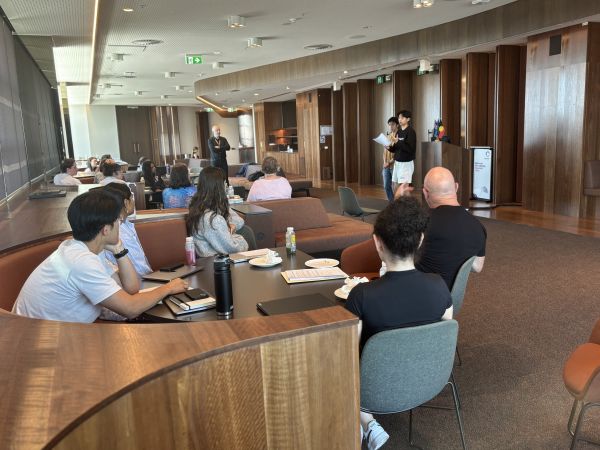
Held at the Victorian Comprehensive Cancer Centre (VCCC), the half-day event connected students with individuals with lived cancer experiences (patients and carers), researchers, and educators from the department.
The students were inspired to hear personal stories shared by patients about their cancer diagnoses and healthcare journeys, and connected with the ways patient engagement can enhance research.
Jeff Chum, an Honours student, felt privileged to converse with patients who generously provided their time, and a perspective on research contributing to both personal and grander challenges.
"In collaborating with patients, we learnt that it is really important that we are building rapport, and showing that we value their, insight, time and efforts."
"We spoke to Paul on his experience as a patient, who emphasised that we are a new generation of researchers learning about the importance of patient engagement from the beginning, understanding that they are real people who hold so much weight to what we do and why we are trying to do it."
"I've never really thought about the consumer side of research - I've thought of that more as the clinical aspect," said Aaron Brunker, another Honours student.
Giselle Thiele, an Honours student, enjoyed hearing about patient experiences with basic research and communicating with researchers.
"I think that having that consumer perspective can help us get out of our little pigeon holes—for lot of us the only exposure we have had to patients is friends or family, and it is a very different situation as you are not thinking about it from a research or scientific perspective, you are thinking about it from a personal perspective," she said.
Katie Gdak, an Honours student, was struck by the importance of financially remunerating patient advisors or consumers, to broaden the demographics of people and perspectives of those who are engaged with research.
"I hadn't considered the variety of ways that they can provide valuable guidance for research, like what they value for their treatments, or even that they can help with grant proposals," she said.
Masters student Helayna Christofi noted the importance of communicating to lay audiences.
"At uni you learn about scientific writing, but it is so important to be able to communicate it to everyone and having that consumer there explaining that we need to communicate in a way that the patients and public, the wider community can understand. If we are doing science there is no point in doing it if we aren't communicating to the public how it will affect them."
The students also heard perspectives from Dr Walid Kamoun, Global Head of R&D Oncology at Servier, an independent global pharmaceutical company based in Paris, France, and researcher Sharelle Joseland, who regularly engages patients in research studies and as research advisors, who discussed the importance of engaging with patient collaborators in biomedical research.
The workshop facilitated small group discussions focusing on key questions:
- How can collaboration between patients/carers and researchers enhance the quality of research?
- How can both researchers and patients/carers benefit from engaging with each other? Can any type of biomedical/clinical research benefit from this type of engagement?
- What are different types of challenges that may act as barriers to more or better engagement?
To conclude the session, student representatives summarised take-home messages from each discussion topic, emphasising the value of patient and researcher collaboration in advancing biomedical research.