New Blood Test Offers Hope for More Effective Ovarian Cancer Treatment
University of Melbourne researchers have contributed to groundbreaking clinical research identifying a blood test that can reveal which women are more likely to respond to PARP inhibitor therapy for ovarian cancer.
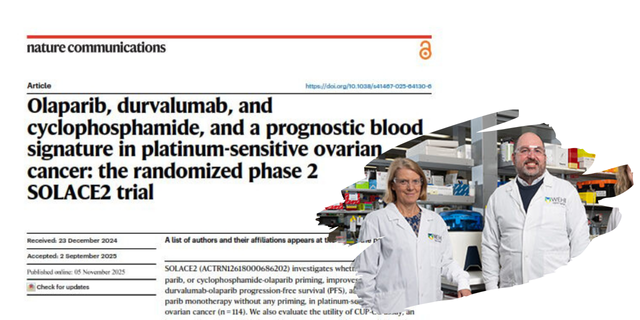 Pictured above Prof Clare Scott AM & A/Prof Matthew Wakefield
University of Melbourne researchers Professor Clare Scott AM & A/Prof Matthew Wakefield have contributed to groundbreaking clinical research identifying a blood test that can reveal which women are more likely to respond to PARP inhibitor therapy for ovarian cancer.
The four-year SOLACE2 trial, which was co-led by the University of Sydney NHMRC Clinical Trials Centre, RMIT University and WEHI, conducted across 15 Australian hospitals and coordinated by the Australia New Zealand Gynaecological Oncology Group (ANZGOG), evaluated a new companion blood test alongside strategies for priming the immune system to enhance treatment effectiveness.
The promising new blood test measures immune biomarkers that reflect the movement of cancer-destroying immune cells towards tumour cells, creating a simple 'biomarker signature' in blood that may be a better guide to treatment response than the current gold standard HRD test.
Department of Obstetrics, Gynaecology and Newborn Health researcher Professor Clare Scott AM, Chair of ANZGOG and leader of WEHI's Ovarian and Rare Cancer Laboratory, highlighted a crucial finding: immune cells within the cancer significantly affect response to PARP inhibitor therapy. "A clear indication of who would respond to treatment came from predicting whether effector T cells could increase their migration into the tumour, where they can start killing the cancer cells," Scott said. "Now that we understand this is a vital factor for cancer control, we could also potentially improve treatments by focusing on promoting this beneficial migration of immune cells in the future."
More than 300,000 women are diagnosed with ovarian cancer globally each year, including 1700 in Australia.
Whilst the new test is not yet available for routine clinical use, the findings represent a significant step towards more effective, personalised ovarian cancer treatment. The study has been published in Nature Communications.
You can view the paper here: Olaparib, durvalumab, and cyclophosphamide, and a prognostic blood signature in platinum-sensitive ovarian cancer: the randomized phase 2 SOLACE2 trial”, published in Nature Communications (DOI: 10.1038/s41467-025-64130-6).