Doctor of Medicine / Master of Biomedical Engineering Pathway
The Melbourne Medical School and Department of Biomedical Engineering are excited to introduce a new intercalated Doctor of Medicine (MD)/ Master of Biomedical Engineering (MBiomEng) program.
The MD/MBiomEng program provides a unique opportunity for eligible, highly motivated students who have completed a Biomedical Engineering Systems major prior to commencing the MD, to undertake an accelerated pathway to a career as medically-trained Biomedical Engineer.
By dedicating their Discovery choices to Engineering subjects, these students will be able to graduate with a Doctor of Medicine and a Master of Biomedical Engineering in 5 years.
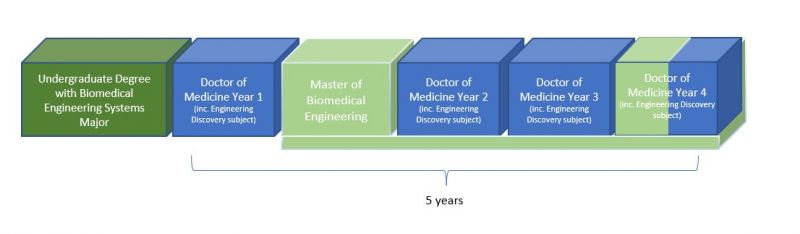
Interested students without the prerequisite Engineering Systems major in their undergraduate degree may also be considered but will be required to complete an additional year of study in the Master of Biomedical Engineering and will take six years to complete both degrees.
Applicants who:
- meet the mathematics and science prerequisite entry requirements for the Master of Biomedical Engineering (e.g. by completing the university’s Biomedical Engineering Systems major); AND
- who are successful in competitive entry to the Doctor of Medicine course
may apply for the combined MD- MC-BioMEng program, attaining both degrees and professional recognition by the Medical Board of Australia and Engineers Australia in five - six years rather than seven.
Successful Doctor of Medicine applicants who have completed the Biomedical Engineering Systems major during their undergraduate studies will be provided information in their MD course offer, on how to apply for the MD/MBiomEng pathway.
Successful applicants will then be notified and guided to enrol in the appropriate Engineering subject as their Year 1 Discovery selective to ensure that they meet the requirements of both the MD and the Master of Biomedical Engineering.
Following successful completion of Year 1, students in the pathway will take a break from their medical studies for one year and undertake a dedicated 12 months enrolment in the Master of Biomedical Engineering. Upon return to the MD students will re-commence and enter Year 2 of the MD course and be enrolled in the appropriate Discovery selectives in Year 2 - 4 that will allow them to complete both courses in the accelerated time.
Detailed information on the course structure can be found here.
-
For further information about the Doctor of Medicine / Master of Biomedical Engineering pathway please submit an enquiry here.
Application and Enrolment
-
While you are enroled in the Master of Biomedical Engineering your MD studies will be suspended and then resumed once you return to clinical studies. You may be enrolled in a “holding” subject of the MD to allow you to maintain some clinical contact during your Bioengineering studies.
-
MD students who receive an offer to undertake the Master of Biomedical Engineering will commence the Master of Biomedical Engineering after successful completion of the first year of the MD.
-
MD students applying for the intercalated pathway do not receive preferential entry into the Master of Biomedical Engineering and will be competing alongside all other applicants for a place in the Master of Biomedical Engineering.
Important things to consider
-
For some students, undertaking this pathway and deviating from the MD, could affect your student support payments through Centrelink. If you are a support payment recipient, you are strongly advised to check with Centrelink and be aware of the implications on payments before proceeding with the pathway.
Students wanting to complete the intercalated Doctor of Medicine / Master of Biomedical Engineering program must review the below information regarding the expected structure for the program to ensure successful completion within 5 years.
Course Plan
| Year | Semester | 12.5 credit point | 12.5 credit point | 12.5 credit point | 12.5 credit point |
|---|---|---|---|---|---|
| 0* | 1 | Foundation Selective | BMEN20003 Applied Computation in Bioengineering | BMEN30010 Mechanics for Bioengineering | BMEN30006 Circuits and Systems |
| 2 | Foundation Selective | BMEN20002 Anatomy and Physiology for Bioengineering | BMEN30009 Introduction to Biomaterials | BMEN30008 Biosystems Design | |
| 1^ | 1 | MEDS90031 Foundations for Clinical Practice (Year Long subject) | Bioengineering Elective (see note 1) | ||
| 2 | MEDS90003 Student Conference 1 | ||||
| 2# | 1 | BMEN90038 Biomechanics | BMEN90037 Bioengineering Data Analytics | BMEN90033 Bioinstrumentation | BMEN90039 Biomed Eng Management and Regulations |
| 2 | BMEN90036 Biofluid Mechanics | BMEN90035 Biosignal Processing | Bioengineering Elective (see note 1) | Bioengineering Elective (see note 1) | |
| 3~ | 1 | MEDS90004 Principles of Clinical Practice 2 (Year Long subject) | Bioengineering Elective (see note 1) | ||
| 2 | MEDS90005 Student Conference 2 | ||||
| 4~ | 1 | MEDS90020 Principles of Clinical Practice 3 (Year Long subject) | Bioengineering Elective (see note 1) | ||
| 2 | MEDS90022 Student Conference 3 | ||||
| 5 | 1# | Biomedical Research Project (see note 2) | |||
| 2~ | MEDS90024 Student Conference 4 | MEDS90025 Transition to Practice | |||
Subject Code Key and Notes
| MEDS (green) | Subject from the MD course |
| BMEN (white) | Subject from the MBiomEng course |
* Year 0: Students undertaking this pathway are expected to have completed subjects within Year 0 through their undergraduate degree (either in the Bachelor of Science or Bachelor of Biomedicine) with a Biomedical Engineering Systems major.
^ Year 1: Students will commence their enrolment in the Doctor of Medicine (MD) course.
# Year 2 & Semester 1 of Year 5: Students will be enrolled in the Master of Biomedical Engineering course and will be placed on a Leave of Absence from the MD course.
~ Year 3, 4 & Semester 2 of Year 5: Students will be enrolled in the Doctor of Medicine course and will be placed on a Leave of Absence from the Master of MBiomEng course.
More information about the individual courses' full structure and rules can be found via the course Handbook links below. Please note that for students undertaking the intercalated pathway are number of subjects are cross-credited and so some course information in the Handbook might not be relevant.
Note 1: Bioengineering Electives
Students will undertake 5 Bioengineering Elective subjects, which must be selected from the table below.
Semester 1
| Subject Code | Subject Name |
|---|---|
| BMEN90021 | Medical Imaging |
| BMEN90027 | Systems and Synthetic Biology |
| BMEN90029 | Soft Tissue and Cellular Biomechanics |
| BMEN90040 | Process Eng for Biomedical Technologies |
| COMP90016 | Computational Genomics |
Semester 2
| Subject Code | Subject Name |
|---|---|
| BMEN90002 | Neural Information Processing |
| BMEN90011 | Tissue Engineering & Stem Cells |
| BMEN90022 | Computational Biomechanics |
| CHEN90039 | Pharmaceutical & Biochemical Production |
| COMP90014 | Algorithms for Bioinformatics |
Disallowed Bioengineering Electives
Note that other subject are not approved for the MD/MBiomEng Bioengineering electives, regardless of information in the course Handbook. It is particularly important that the following subjects are not selected by students undertaking the MD/MBiomEng program:
| Subject Code | Subject Name |
|---|---|
| ENGR90034 | Creating Innovative Engineering |
| ENGR90039 | Creating Innovative Professionals |
| ENGR90021 | Critical Communication for Engineers |
| ENGR90051 | Interdisciplinary Design for Engineers |
| ENGR90033 | Internship |
Note 2: Biomedical Engineering Research Project
During their final year research project, MD/MBiomEng student must undertake BMEN90018 as a Semester 1 Capstone project and cannot replace BMEN90018 with BMEN90030 BioDesign Innovation. Further information on the research project will be provided after enrolment in the pathway.
What if I cannot complete the above course plan?
Students who are unable to complete the MD/MBiomEng program following the prescribed course structure may be ineligible to continue with the intercalated pathway and may be required to revert to the standard MD or Master of Biomedical Engineering program.
Meet the students

Christopher Bowman – MD/Biomedical Engineering Student, St Vincent’s Hospital
- Completed a Bachelor of Science, majoring in Bioengineering Systems
- Honours in Biomedicine at the Bionics Institute, researching pelvic nerve recordings under A/Prof Sophie Payne and Prof James Fallon, continued the work as a research assistant
- Commenced the Doctor of Medicine (MD) in 2023
- Interested in neuroscience and medical devices that record biological signals
- Planning to explore this further in a fourth-year research project, potentially returning to the Bionics Institute
I’m excited about how ACMD can support the development of my biomedical engineering interests while staying closely connected to clinical practice. Speaking with patients during placement has reaffirmed my passion for using engineering to improve care and quality of life. ACMD’s proximity to the hospital will help sustain this passion and keep patients at the centre of my work.
Felix Zhou – MD/Biomedical Engineering Student, MD2
- Passionate about bridging clinical care with technological innovation
- Undertaking the MD/Biomedical Engineering pathway, which provides a unique perspective on how engineering can address real-world healthcare challenges
- Contributed to research at the Monash MedTech Lab, working on an AI explainability project using a sparse autoencoder (SAE) model
- Particularly interested in medical device design and the use of artificial intelligence in diagnostics
- Looking ahead to a fourth-year research project focused on these areas
- Excited by the collaborative potential of the ACMD environment, where clinicians, engineers, and researchers work side by side
Being based at ACMD offers an exciting opportunity to grow in a space purpose-built for innovation. I’m eager to contribute to its vision and apply my skills in a truly interdisciplinary setting.