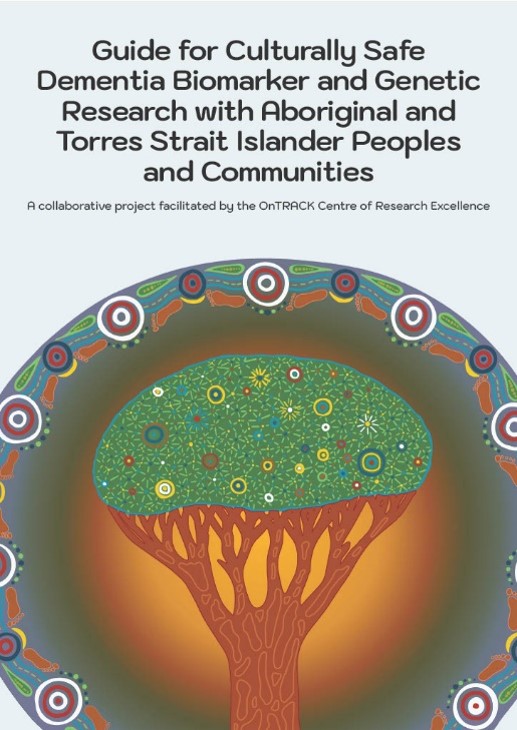
New Guide for Culturally Safe Dementia Biomarker and Genetic Research with Aboriginal and Torres Strait Islander Peoples and Communities, released by OnTRACK
Dementia biomarker and genetic research is advancing rapidly, with the potential to improve diagnosis, care and outcomes for people living with dementia. This includes research involving biological samples, imaging and other health data. While these approaches offer promise, they also raise important ethical and cultural considerations, particularly when research involves Aboriginal and Torres Strait Islander peoples.
While national initiatives such as the National Centre for Indigenous Genomics (NCIG) and the Australian Alliance for Indigenous Genomics (ALIGN) have established ethical frameworks for genomic research, until now no guidance has specifically addressed dementia biomarker and genetic research with Aboriginal and Torres Strait Islander peoples.
This gap matters because:
- People living with dementia can have fluctuating or impaired decision-making capacity, which needs special consideration, particularly when giving consent for the collection, future use, storage or disposal of samples or data.
- Many emerging biological or genetic markers are not yet validated for clinical care.
- Results of research tests may only indicate the likelihoods or risks of developing dementia rather than offering a definitive diagnosis (probabilistic results). This may, in turn, lead to concern or worry.
- Biospecimens may carry deep cultural and relational significance, so their collection, use, storage and disposal need to be very carefully considered.
The NHMRC funded OnTRACK (Teaching, Research and Community Knowledges) Centre of Research Excellence identified this gap as a community priority. OnTRACK supported the development of dementia-specific guidance that is designed for researchers conducting, managing or governing dementia biomarker, genetics or genomics research with Aboriginal and Torres Strait Islander peoples. Grounded in the principle that Aboriginal and Torres Strait Islander peoples should be involved at every stage of the research process, the guide emphasises Indigenous leadership, genuine partnership and shared decision-making, including families and carers. It covers community engagement, culturally safe consent and communication, governance of samples and data, ethical storage and repatriation and the responsible return of findings.
This guide extends existing ethical frameworks into this evolving area, supporting researchers and institutions to conduct dementia biomarker and genetic research that is ethically sound and accountable to Aboriginal and Torres Strait Islander peoples.
Click here to download a copy of the guide.
For more information please reach out to OnTRACK Coordinator, Dr Penny O’Brien (penny.obrien@unimelb.edu.au).