Sex and Gender in Health and Medical Research
On 13 March, the Melbourne Medical School hosted Professor Cara Tannenbaum from the Université de Montréal, Canada, for a special presentation held in the Doherty Auditorium.
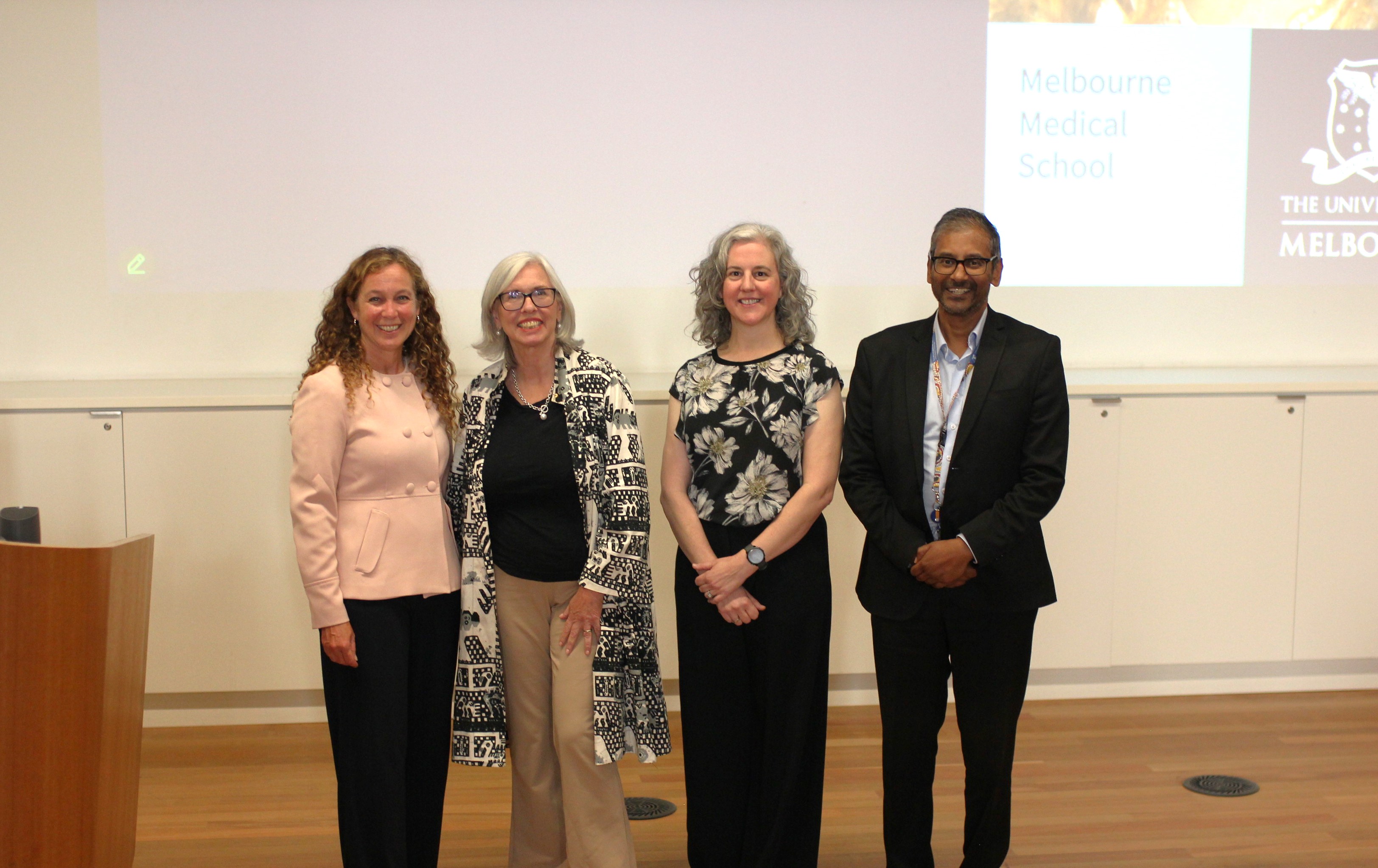
Pictured: Professor Cara Tannenbaum, Professor Christobel Saunders AO, Professor Anna Ryan, Professor Sarath Ranganathan.
An internationally recognised expert in sex and gender in research, Cara was in Melbourne as a Thinker in Residence at Deakin University, raising awareness and supporting the implementation of the new NHMRC Statement on Sex, Gender, Variations of Sex Characteristics and Sexual Orientation in Health and Medical Research, as well as the Government of Victoria’s new women’s health programs.
Speaking to an audience of staff and students from across the Faculty of Medicine, Dentistry and Health Sciences, Cara provided compelling historical examples that illustrated why it is essential to explore differences in sex and gender when conducting research. She outlined the NHMRC’s new statement, which strongly recommends considering sex and gender across all stages of research, from formulating the research question and reviewing the literature, to study design, sampling and recruitment, analysis and interpretation, and ultimately, reporting and translation. The urgency behind the need to develop rigor when considering these questions is to ensure that health and medical research generates the maximum possible positive impact for all end users.
Cara emphasised the need for a cultural shift to systematically raise the standards for considering sex and gender in research. This shift includes educating researchers about key terminology, the differences between sex and gender as concepts, and the implications of rigorously incorporating these considerations into their research methodology and practice. It also involves embedding these principles in teaching and engaging students early in their training to ensure future researchers and clinicians develop a strong foundation in this area. Cara cautioned the audience that there are dangers in failing to act, including, among other consequences, the potential for poorer outcomes with grant applications when the NHMRC guidelines are not properly addressed.
Drawing upon her experiences implementing change within the Canadian research ecosystem, Cara invited the University of Melbourne to take a leadership role through developing education and training initiatives, creating resources, and recognising champions who promote best practice in considering sex and gender in their research. The Melbourne Medical School benefited greatly from Cara’s visit, and we will respond to her call to action by raising awareness of the importance of considering sex and gender in research while actively promoting and recognising excellence in this area.
If you missed this event, you can watch the recording here.