Whose Care is Left Behind?
Project Details
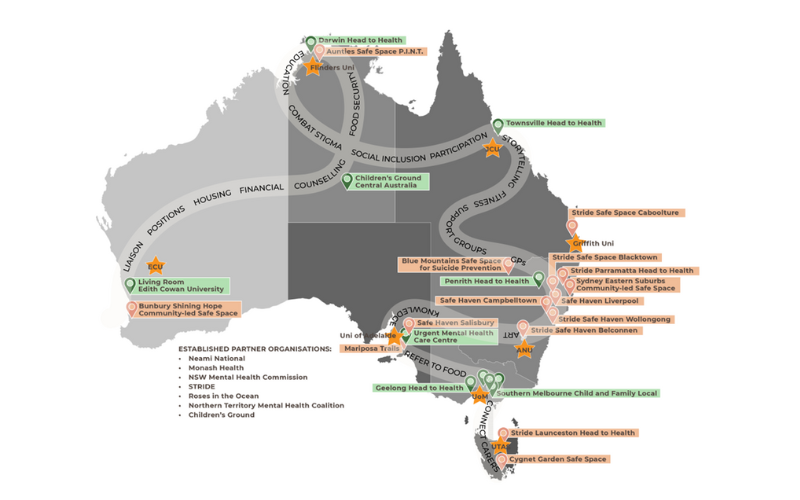
Whose care is left behind? is a new mental health research initiative that seeks to address structural inequalities affecting Aboriginal and Torres Strait Islander communities, rural, regional and remote communities, people from culturally diverse backgrounds and people living with mental ill-health. By creating 25 community action nodes around new service innovations focused on more flexible, placed-based, culturally-led prevention, intervention and care models and delivering care across the life course, the initiative will grow multi-level collective strategies to respond to inequalities.
Led by the ALIVE National Centre for Mental Health Research Translation, the five-year project (2024-2029) is a collaboration between nine universities and seven mental health organisations across 25 locations. It is the sole project to be awarded Medical Research Future Funding as part of the Million Minds Mental Health Research Mission (Stream 1 Trageted Research Call). The project leads are Victoria Palmer, Sandra Eades (Noongar), Michelle Banfield.
Why is this project important?
People from culturally diverse communities or rural and remote locations experience challenges in accessibility when seeking and receiving mental health and support for social and emotional wellbeing care. Many modern-day mental health service models are founded in Western culture and beliefs. They are not always culturally nor appropriate and can impact negatively on social and emotional wellbeing. It can also be hard for people from priority populations to access the care they need due to the rigid operating hours, eligibility criteria and limited localities with appropriately trained workforces accustomed to working with people with lived-experience as peer workers.
Recent data has shown that priority populations are choosing to access new models of care based in communities. We want to find out what these services are and whether they are being tailored for priority populations with accessibility across cultural responsiveness, lived-experience workforces and communication.
What will the project do?
- 25 community action nodes will be created across Australia.
- A new national database will be codeveloped with sites for type of services, access demographics, staffing (skill set and training), structural inequalities and relational outcomes.
- Using learnings from social and emotional wellbeing programs that show established First Nations-led approaches such as partner organisation Children’s Ground, Northern Territory we will create ecomaps maps and use the findings to determine which support nodes to prioritise and which structural inequalities to target, then, co-create the most effective strategies that could be implemented.
What does Whose Care hope to achieve?
- A participatory health ecosystem that provides connected and enduring care that is led by the strengths of communities.
- Services and new models of care that are embedded in place and part of an ecosystem response to addressing structural inequalities.
 Lead Researchers and collaborators
CIA | Prof Victoria Palmer – The University of Melbourne |
CI | Prof Sandra Eades (Noongar) – The University of Melbourne |
CI | Prof Michelle Banfield – The Australian National University |
CI | Prof Sarah Larkins – James Cook University |
CI | Prof James Smith – Flinders University |
CI | A/Prof Amanda Neil – University of Tasmania |
CI | Dr Wendy Hermeston (Wiradjuri) – The University of Melbourne |
CI | Prof Naomi Sunderland (Wiradjuri) – Griffith University |
CI | Dr Matthew Lewis – The University of Melbourne |
CI | Dr Jennifer Bibb – The University of Melbourne |
CI | Dr Sarah Wallace – The University of Queensland |
CI | Dr Rubayyat Hashmi – The University of Adelaide |
CI | Dr Amanda Cole – Edith Cowan University |
CI | Prof Eduard Hovy – The University of Melbourne |
CI | William Tilmouth (Arrernte Elder) – Children’s Ground |
AI | Priscilla Ennals – Monash University |
AI | Phillip Orcher (Muruwori | Gumbaynggirr) – The University of Melbourne |
AI | Dr Daniel Rock – University of Western Australia |
AI | Prof Claire Donnellan – Edith Cowan University |
AI | Dr Antoni Caserta – Monash Health |
AI | Jane Vadiveloo – Children’s Ground |
AI | Veronica Doolan (Arrernte) – Children’s Ground |
AI | Carol Turner (Arrernte) – Children’s Ground |
AI | Felicity Hayes (Arrernte) – Children’s Ground |
AI | Amunda Gore (Arrernte) – Children’s Ground |
AI | Jen Lorains – Children’s Ground |
Partner Universities
Partner Organisations
Funding
Funded by Million Minds Mission Mental Health Targeted Research Grant as part of the Medical Research Future Fund (2024-2029)