Project receives funding to improve understanding of bacteria-caused bowel cancer
Researchers have received funding to better understand bowel cancer caused by gut bacteria and ultimately prevent its development.
Associate Professor Dan Buchanan’s Colorectal Oncogenomics Group at the Collaborative Centre for Genomic Cancer Medicine, a joint venture of the University of Melbourne and Peter Mac, have received funding from the Cancer Council Victoria Grants-in-Aid program.
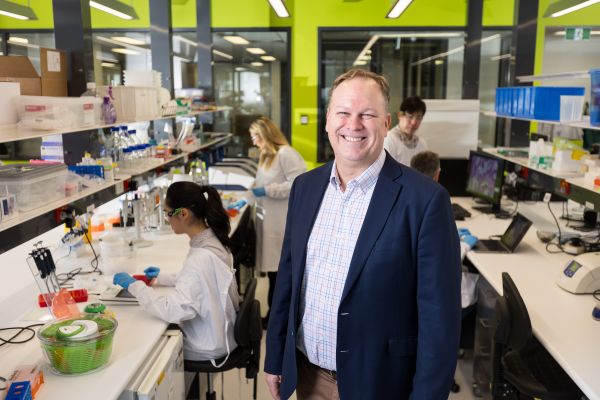
"The incidence of bowel cancer in people under 50 is increasing, and we know that approximately 90 per cent of these cases are not explained by commonly known hereditary causes," said Associate Professor Buchanan.
"By better understanding bacteria-caused bowel cancer we can identify risk factors and work to stop its development."
Bacteria-caused bowel cancer is a recent discovery linked to E. coli. The team of researchers identified a “signature” of DNA damage caused by this bacterium that can be detected in bowel cancer tissue to identify people who have bacteria-caused bowel cancer.
"We'll be exploring if people who develop this type of bowel cancer may be more likely to develop a second bacteria-caused bowel cancer, and if people close to those affected may also be at risk due to potential exposure to the same bacterium."
"This potential link between bowel cancer development in multiple family members because of E. coli infection due to shared environment, lifestyle or diet has never before been explored."
"This information will ultimately help guide clinicians in treating both patients and their families to prevent bowel cancer."
The project team includes two people with personal understanding of early-onset bowel cancer, acting as consumer advocates, whose own experiences have helped to drive the direction of this important research.