Discovering the causes of colorectal cancer, reducing its incidence, and improving precision prevention.
Cancer of the colon and rectum or bowel cancer takes the lives of over 5,000 Australians every year. National incidence of colorectal cancer have increased dramatically in young people. It is now the leading cause of cancer related death for 20 - 39 year olds in Australia. The reasons for this increase are unknown.
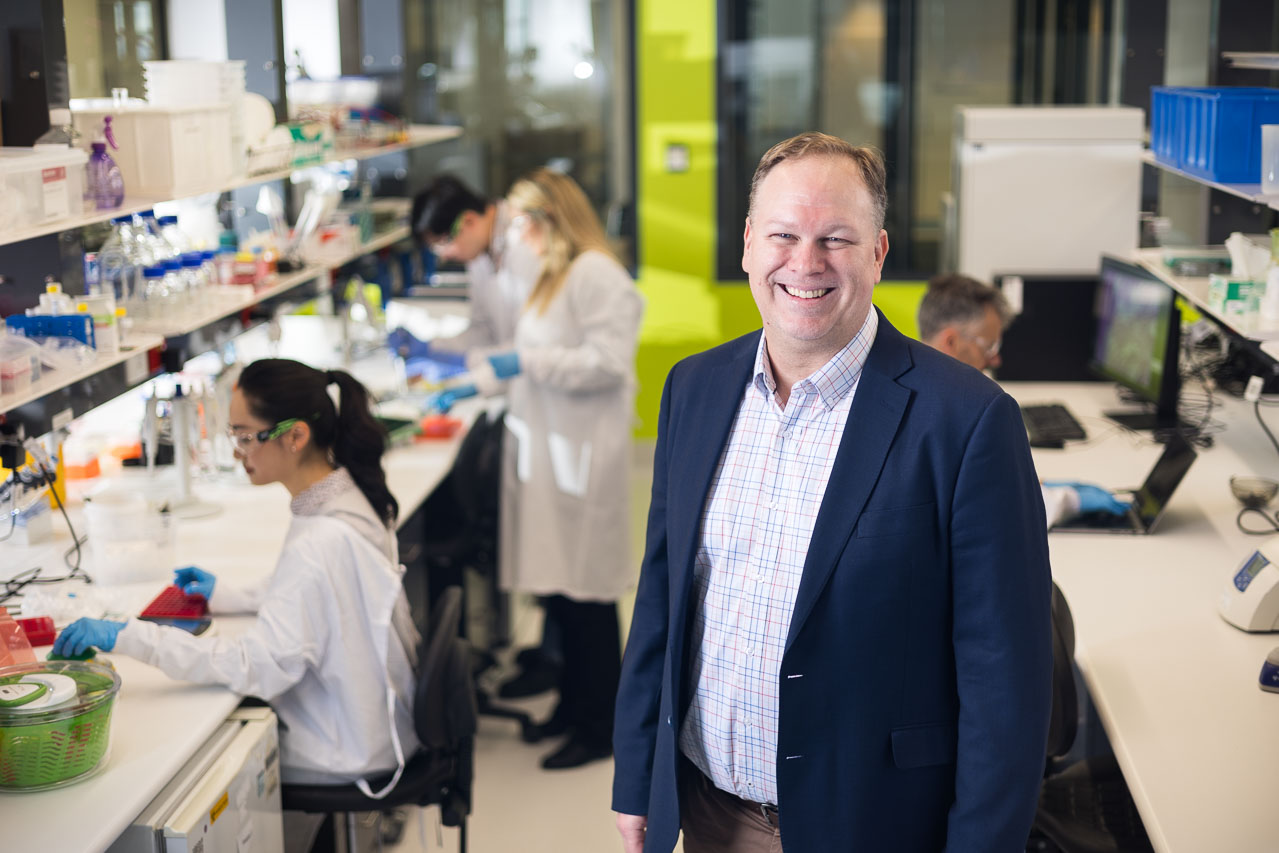
Led by Associate Professor Daniel Buchanan, the Colorectal Oncogenomics Group’s research aims to identify the causes of colorectal cancer and colonic polyposis, particularly in young adults. They are developing methods to improve the diagnosis of hereditary cancer syndromes.
Their goal is to enable prevention and early detection by identifying people with an increased risk of the disease, to inform primary and secondary prevention strategies.
One of the ways they achieve this is by identifying and investigating relevant subtypes of colorectal cancer through comparison of tumours and pre-malignant lesions known as polyps. The team builds complex cancer and polyp profiles including information on the genomic and methylomic landscape, intratumoural microbiome, immune cell response, histopathological characteristics, clinical data, and environmental and lifestyle factors.


ANGELS study
Colorectal cancer in people aged between 20-39 is leading cause of cancer-related deaths in Australians. Rates of early-onset colorectal cancer have doubled in young people and continue to rise, for reasons that are currently unknown.
The ANGELS study recruits individuals from Family Cancer Clinics and Genetic Services across the country, applying novel genomic and computational approaches to better understand the cause of early-onset colorectal cancer, including the role of gut bacteria. This work has provided novel insights into the causes of tumour DNA mismatch repair deficiency and provided a template to improve diagnostic approaches to identify people with Lynch syndrome in Australia.
The Genetics of Colonic Polyposis Study (GCPS)
People with multiple pre-malignant lesions in the colon called polyps have an increased risk of developing colorectal cancer. The genetic basis for a large proportion of people with colonic polyposis is unknown making clinical management of families challenging. The cause for Serrated Polyposis Syndrome (SPS), the most common polyposis syndrome, is largely unknown where affected individuals and their first-degree relatives have an increased risk of developing colorectal cancer.
The GCPS comprises the world’s largest study of SPS and seeks to identify people at risk of SPS, improve the understanding of disease initiation and progression and treatment of the condition.
Sebaceous skin lesions and Lynch syndrome (Muir-Torre Study)
FAPI-CUP is an MRFF-funded clinical trial led by Prof Linda Mileshkin at the Peter Mac testing the role of a new PET radiopharmaceutical agent called FAPI to help resolve CUP primary cancer diagnosis compared to conventional FDG-PET. FAPI also has therapeutic potential to deliver targeted radiation therapy to a tumour by attaching a particle emitting radioactive element to the FAPI compound.
The RADIO lab is investigating the additive value of clinical whole-genome and transcriptome sequencing of CUP patients with results from FAPI and FDG-PET scans. This will also identify potential genomic biomarkers of FAPI radiopharmaceutical treatment response.
The International Colon Cancer Family Registry Cohort (CCFRC)
Associate Professor Daniel Buchanan is one of the Principal Investigators of the International Colon Cancer Family Registry Cohort - the world’s largest cohort study of colorectal cancer causes and outcomes.
The CCFRC is a family-based cohort enabling researchers to monitor colorectal cancer across multiple generations, applying new technologies to understand the causes of colorectal cancer. This study has contributed to over 500 publications assessing risk, prognosis, and quality of life, and led to the identification of new genes that predispose people and families to colorectal cancer.