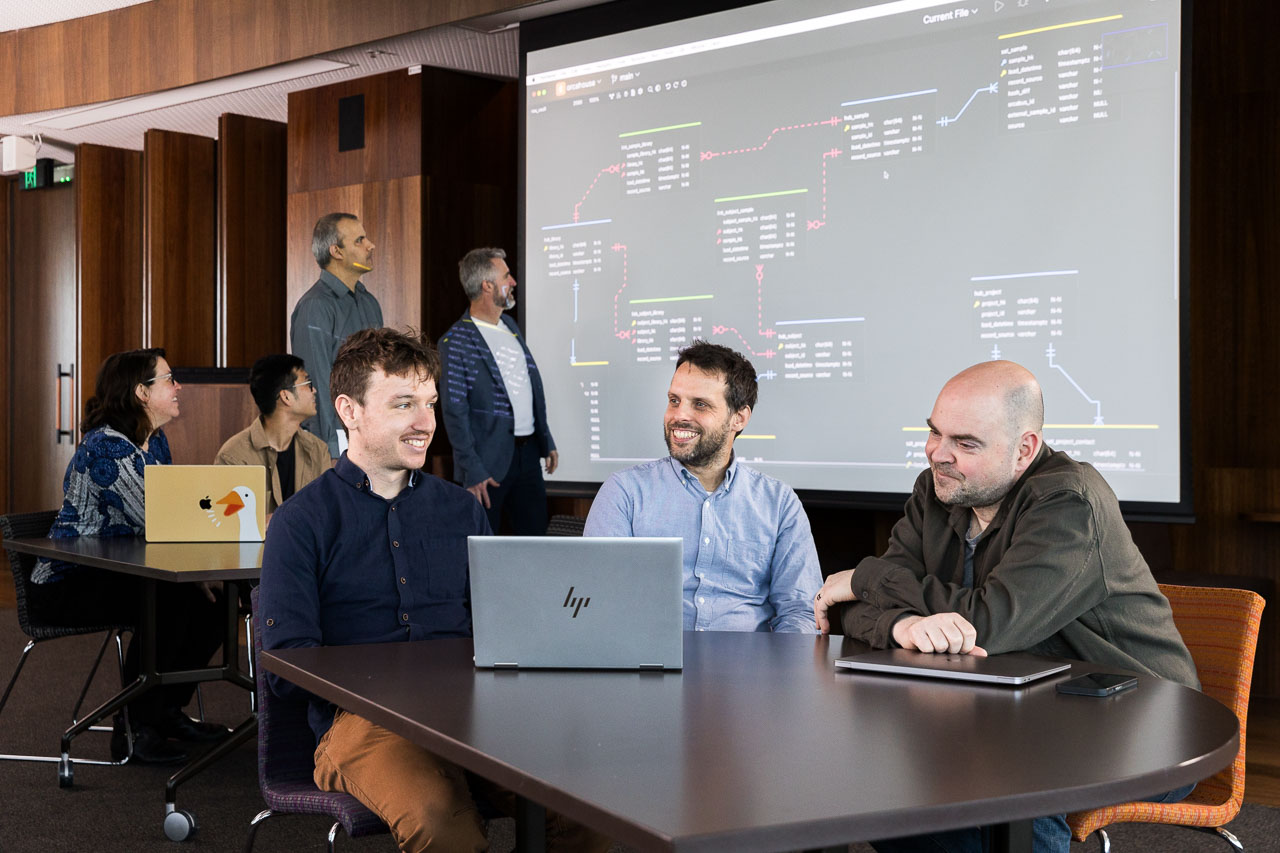
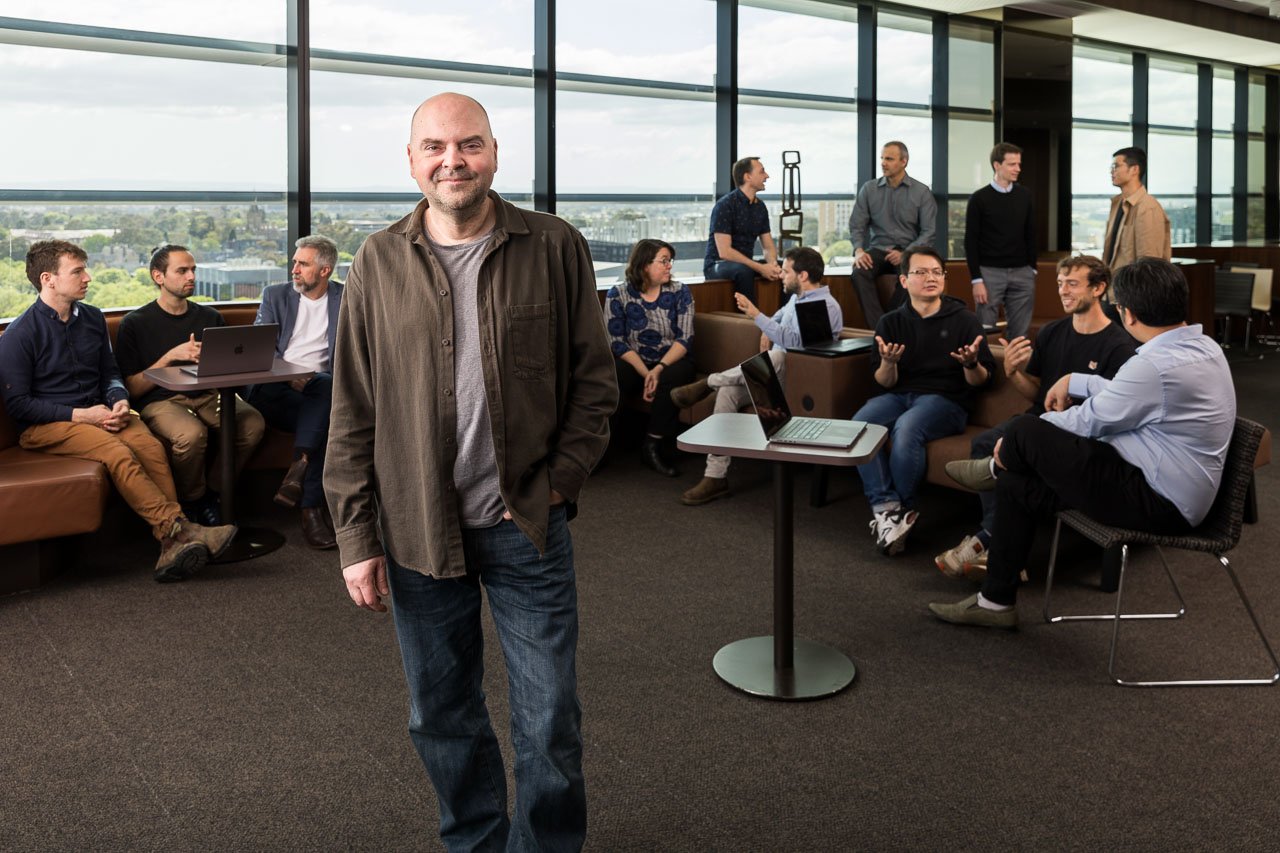
Developing workflows, infrastructure and standards to support the use of genomic data in a clinical setting.
The sequencing and analysis of cancer genomes can transform diagnosis and treatment options. The process relies on scalable, reproducible and accurate interrogation of data in timeframes that matter to patients, supported by the right infrastructure.
Professor Oliver Hofmann's Genomics Platform Group works in close collaboration with the international bioinformatics community to develop and maintain analytical workflows to identify genomic alterations. For rare and challenging cancer cases, it is vital that any genomic data can be confidently compared to local and international data sets analysed under the same standards — enabling researchers and clinicians to process, analyse and aggregate large-scale sequencing data.
The Genomics Platform Group is a national leader in the establishment of infrastructure needed to manage and share huge sets of uniform data.
They work closely with multiple partners around the world including the Global Alliance for Genomics and Health (GA4GH), Genomics England and the Hartwig Medical Foundation to achieve greater international coordination and enable the exchange of data between large scale cancer cohorts.



Dr Felipe Jimenez Ibarra
Research Software Engineer (Data Manager)
Victor San Kho Lin
Human Genomics Data Technology Lead (Senior Research Software Engineer)
Ray Liu
Research Software Engineer
Alexis Lucattini
Senior Bioinformatician, Genomic Medicine

Marko Malenic
Research Engineer

Helen Mitchell
Bioinformatician
Andrew Patterson
Senior Research Software Engineer
Florian Reisinger
Systems Architect

Stephen Watts
Senior Bioinformatician
Developing workflows for existing and novel clinical genome assays
The Genomics Platform Group works with international partners to develop and improve workflows for the analysis of standard assays (whole genome, transcriptome and panel-based sequencing), with partners Illumina (DRAGEN) and the Hartwig Medical Foundation (oncoanalyser).
The aim is to apply these workflows to large, international cohorts to harmonise datasets to allow for the exchange of aggregated cancer information across international borders in an extension of previous efforts such as the International Cancer Genome Consortium.
In the longer term, the group aims to support minimal residual disease testing and coordinate workflow development with other international partners.
Automation and maintenance of clinically accredited workflows
The group supports the accreditation of workflows by the National Association of Testing Authorities (NATA)—the authority responsible for accrediting laboratories, inspection bodies, and calibration services in Australia and beyond—through continuous testing, maintenance and evaluation.
They also work with partners, such as Illumina, to maintain analytics platforms and continuously deploy new algorithmic improvements and evaluate their impact on benchmark data.
Contributing to the establishment of a national genomics infrastructure
The Genomics Platform Group collaborates with Australian Genomics to contribute to the planning, prototyping and evaluation of computational infrastructure for the national management of genomic information. This includes maintaining Australian Genomics’ data warehouse, supporting international data sharing, and shaping national guidelines for effective re-use of clinical and research data.
The team is also establishing a clinical infrastructure platform with basic variant sharing capabilities to explore the viability of exchanging limited genomic variant information to support rare disease diagnostics. As part of the Australian BioCommons GUARDIANS project, the group is looking to establish ‘mutually trusted research environments’ to ensure relevant data can be moved safely between secure processing environments, a key requirement to re-analyse large genomic data sets.
Contributing to the development of genomic data standards
The platform group utilises funding from Australian Genomics, the Australian BioCommons and The Advanced Genomics Collaboration to contribute to international standards development through the Global Alliance for Genomics and Health (Crypt4GH, htsget, Beacon, RefGet and others). This ensures data is securely stored and managed in close alignment with international standards and reference implementations such as Europe’s Genomic Data Infrastructure Project.
Through the GA4GH National Initiatives Forum, the group is involved in collaborative projects such as a proposed data harmonisation project with Genomics England, DKFZ Heidelberg and the Hartwig Medical Foundation to exchange aggregate-level data between large scale cancer cohorts.
TAGC Bioinformatics Platform
Professor Oliver Hofmann and his team also lead the The Advanced Genomic Collaboration's Bioinformatics Platform. Made possible through a partnership between the University of Melbourne and global biotech company Illumina, the Bioinformatics Platform is a cloud-based system that enables the creation, storage and interrogation of national and global-scale genomic datasets.
The platform handles massive amounts of patient information, mapping their entire genome to provide improved diagnosis and more targeted and effective treatments.