Graduate Research: At Risk and Unsatisfactory Progress
Managing graduate research at risk
-
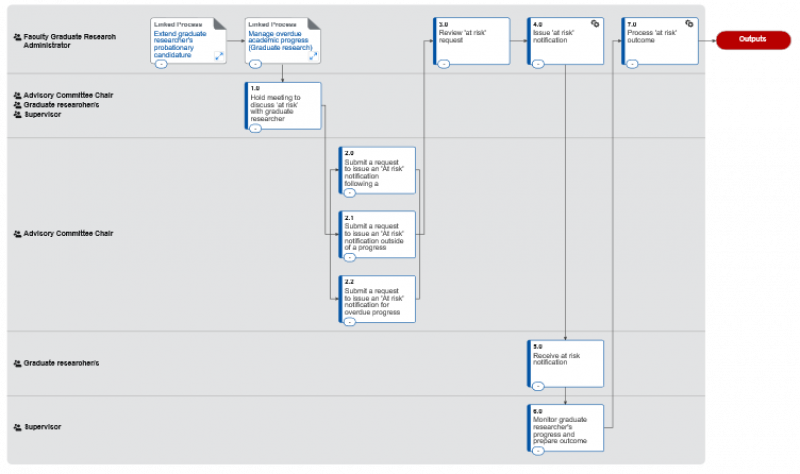
Graduate researchers are classified as at risk of making unsatisfactory progress ('at risk') at any stage of their candidature, including at confirmation, if any academic progress expectations have not been met. At risk of making unsatisfactory progress is an early intervention strategy designed to assist the graduate researcher in returning to satisfactory progress.
The advisory committee can request that a graduate researcher be classified as ‘at risk’ by emailing the faculty GRA if a meeting occurred with the graduate researcher outside of the formal academic progress meeting schedule, or by choosing the ‘at risk’ outcome when completing an online progress review form. For a Confirmation, if ‘extend probationary candidature’ is chosen on the form, the graduate researcher is considered to be at risk of making unsatisfactory progress.
As per the Academic Progress (Graduate Research) policy section 5.13, if the advisory committee expect that the upcoming academic progress review will involve discussions and plans regarding the graduate researcher’s ‘at risk’ status, the supervisor or advisory committee chair must advise the graduate researcher in writing and ensure they are prepared for the discussion and planning to take place. -
- The reason why the graduate researcher is considered at risk of making unsatisfactory progress.
- Progress plan (hurdle requirements to demonstrate satisfactory progress and inclusive of any candidature variations)
- Reasonable deadline to meet the hurdle requirements (up to 3 months)
- Support available
- Advice that continued unsatisfactory progress may lead to termination of enrolment.
-
As per the Academic Progress (Graduate Research) policy section 5.9, graduate researchers must attend academic progress reviews. Failure to attend and to respond to reasonable requests to attend a meeting, is an indicator that there is a risk that progress milestones will not be met.
Any graduate researcher whose academic progress review is overdue has failed to meet their milestone and is deemed to be at risk of unsatisfactory progress. When the overdue academic progress email is sent by the faculty, the graduate researcher’s academic status should be recorded as ‘at risk’ for a period of 10 business days. If the graduate researcher continues to not respond or submit their academic progress review after the notification is sent, unsatisfactory progress should be initiated which may lead to termination of enrolment. -
The Graduate Research Training policy specifies the maximum probationary candidature period for different degrees. If the advisory committee believes that a graduate researcher will not make/has not made the required progress to be confirmed in their candidature by the end of the probationary period, an extension to probationary candidature may be indicated as an outcome to a Confirmation meeting. Since there are concerns that Confirmation may not be achieved, the graduate researcher will be issued with an ‘at risk’ notification by the faculty. This notification will include the list of tasks the Confirmation committee specifies need to be completed by the end of the period.
In this case, if the graduate researcher fails to make satisfactory progress after an extension to probationary candidature has been provided, they are issued with an unsatisfactory notice. It is recommended that the committee should have explored and discussed the option to convert to Masters for a PhD candidate as this option will be discussed at a Course Academic Progress Comitete meeting.
If an extension is requested because the Confirmation is delayed for reasons outside the graduate researcher’s control (eg. committee are not available to meet), the advisory committee chair can email their faculty graduate research administrator to request the extension. Be aware that if a further extension is required, the graduate researcher may be considered to be at risk of unsatisfactory progress. The total combined extensions cannot exceed the maximum period of probationary candidature indicated in the Graduate Research Training policy. -
Schedule a meeting at the end of the ‘at risk’ period to discuss and assess whether the graduate researcher has met their progress requirements. The advisory committee may recommend one of the following outcomes.
Satisfactory progress
If the graduate researcher has met all the requirements by the end of the ‘at risk’ period, the faculty will notify them that their progress is satisfactory, and the 'at risk' period has ended.
Unsatisfactory progress
If the graduate researcher continues to not meet progress expectations and there are serious concerns that timely thesis submission is unlikely, or confirmation of candidature is still not possible, the advisory committee should indicate unsatisfactory progress on the online form or send an email to Graduate Research (Student Administration) with a completed ‘request’ attached.
Further 'at risk'
In some cases, a confirmed graduate researcher who has not reached their maximum course duration and who has demonstrated some progress may be issued with another ‘at risk’ period. Similar to the initial ‘at risk’ period, the graduate researcher should be provided with instructions and additional tasks they will need to achieve by the end of the period. Any notification sent should also include advice on what support they will be able to access during the additional period of intervention and the advice that further failure to meet the requirements may lead to termination of their enrolment.
Managing graduate research unsatisfactory progress
-
Graduate research unsatisfactory progress is a formal intervention period initiated when a graduate researcher’s advisory committee believes a graduate researcher:
- continues to have unsatisfactory academic progress after progress intervention has occurred (‘at risk’ or extension to probationary candidature), or
- has reached their maximum course duration and following a period of ‘at risk’ the advisory committee cannot recommend lapsed candidature (if eligible) because they consider it unlikely the graduate researcher will submit a thesis of examinable quality within the lapsed period.
Once either of the above circumstances is identified the advisory committee must request that an unsatisfactory progress notice be issued.
-
- The reason why the graduate researcher’s progress is deemed to be unsatisfactory.
- Advice that the graduate researcher is required to attend a Course Academic Progress Committee (CAPC) meeting and that the details of the meeting will be received via a separate email.
- The option to bring along a support person to the meeting.
- Advice that there is a requirement to submit a written statement to the CAPC regarding their unsatisfactory progress within 10 business days of the date the notice is sent.
- Support available.
-
When a request to issue a notice of unsatisfactory progress is received or a show cause notice needs to be issued, Graduate Research (Student Administration) will contact the associate dean of graduate research (ADGR) to nominate members for the Course Academic Progress Committee (CAPC). Members of the committee cannot be associated with the research project or the relevant department.
In addition to the members of the committee, the meeting is attended by the graduate researcher, their principal supervisor, and, if available, their advisory committee chair. A CAPC is typically chaired by the faculty ADGR.
For information on the conduct of the hearing and the composition of the CAPC, refer to the Academic Progress Review Policy (Graduate Research) (MPF1363).
Possible outcomes of a CAPC meeting
If a CAPC meeting is held following an unsatisfactory progress notice being issued the committee can:
- confirm that three months should be given to the graduate researcher to achieve the progress requirements and that the hurdle requirements are appropriate.
Alternatively, they may decide that unsatisfactory progress is not appropriate and withdraw the recommendation or recommend another form of intervention, for example, ‘at risk’.
- recommend a leave of absence period be added to the progress plan prior to commencing a three-month unsatisfactory progress period.
- recommend, for a graduate researcher enrolled in a PhD or doctorate, a transfer to an MPhil or masters by research as long as the graduate researcher has not already consumed more than the maximum course duration allowed for the new degree. *
- recommend termination of enrolment and that a show cause notice be issued.
If a CAPC meeting is held following a show cause notice being issued the committee can:
- give the graduate researcher a final opportunity of three months to meet the progress requirements. If, at the end of this three-month period, progress requirements are not met their enrolment is terminated.
- recommend a leave of absence period be added to the progress plan prior to commencing a three-month unsatisfactory progress period.
- recommend, for a graduate researcher enrolled in a PhD or doctorate, a transfer to an MPhil or masters by research as long as the graduate researcher has not already consumed more than the maximum course duration allowed for the new degree. *
- terminate the graduate researcher’s enrolment.
*Note: If the graduate researcher has reached their maximum course duration, a transfer may be considered. If they confirmed:
- on or before 31 December 2017, lapsed candidature may be approved if the Committee believe thesis submission is likely within six months of the start of the lapse period.
- on or after 1 January 2018 late submission may be approved if the Committee believe that thesis submission is likely within six months of the start of the late submission period.
However, if they have already consumed candidature beyond the maximum submission date of the new degree i.e. two years plus one year lapsed candidature or late submission (or 2.5 years for eligible candidates who commenced prior to 1 March 2020), an option to transfer will not be recommended.