Cancer Council Victoria Grant in Aid 2026
Congratulations to the Oncofertility team who have been awarded a CCV Grants-in-Aid to advance fertility restoration for male childhood cancer survivors.
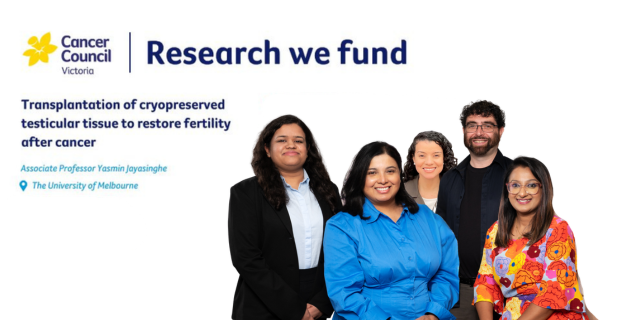
Pictured: Dr Apoorva Bhargava, A/Prof Yasmin Jayasinghe, Dr Diana Navarro-Perez, Dr Michael Assis & Dr Zobaida Edib
Congratulations to the multidisciplinary Oncofertility team from the University of Melbourne Department of Obstetrics, Gynaecology and Newborn Health who have been awarded a prestigious Cancer Council Victoria Grants-in-Aid to advance fertility restoration for male childhood cancer survivors.
The project, titled "Transplantation of Cryopreserved Testicular Tissue to Restore Fertility After Cancer," brings together A/Prof Yasmin Jayasinghe (CIA), Dr. Debra Gook, Prof Kyle Orwig, Prof Margaret Zacharin, Dr Michael Assis, Dr. Zobaida Edib, Dr. Apoorva Bhargava, Dr Tom Manley and Dr Hossam Elzeiny in a collaborative effort to tackle one of the most significant long-term consequences of childhood cancer treatment.
Cancer treatments, whilst life-saving, frequently damage fertility in young patients. Fertility preservation techniques such as egg, sperm and reproductive tissue freezing have become increasingly important in cancer care planning. However, for prepubertal boys, testicular tissue freezing remains an experimental procedure without established techniques to restore fertility from the preserved tissue. This research project will pioneer innovative approaches to mature frozen testicular tissue, enabling it to grow and produce mature sperm that can be collected and stored for future use, offering hope to young survivors seeking to become biological parents.
Beyond the technical advances, the research team recognises the critical importance of understanding the lived experiences of young male cancer survivors. The project will explore survivors' attitudes, concerns and unmet needs related to testicular tissue cryopreservation and transplantation. These findings will be instrumental in developing patient-centred care guidelines and future clinical protocols that genuinely reflect the priorities and concerns of young cancer survivors and their families.
With childhood cancer survival rates now reaching approximately 87 per cent, addressing the long-term quality-of-life impacts of treatment has become paramount. Currently, around 40 per cent of young male cancer survivors experience infertility, yet little is known about their fertility-related needs and concerns. This award-winning project represents a significant step towards closing this knowledge gap and providing meaningful solutions for a generation of survivors navigating life after cancer.