A Tailored Pathway to Empower First Nations Students in Rural Australia
Education is a social determinant of health, yet the proportion of First Nations students enrolled in Australian universities is much lower than their non-First Nations counterparts1 and the reasons are varied.
The barriers to university, including cost, bureaucratic hurdles, relocation, and lack of cultural safety, make entering, enrolling, and completing university courses difficult for First Nations people2. In rural and remote areas, where educational opportunities are already sparse, these challenges are amplified.
To address these barriers, the Department of Rural Health at the University of Melbourne has developed a pathway of postgraduate courses specifically designed for First Nations students. This unique pathway encourages students to live, work and study on Country while pursuing their university studies. It is particularly suited to students who live and work in rural and remote areas, who work in and with their communities, and for those with community and cultural experience but perhaps unfamiliar with the university landscape.
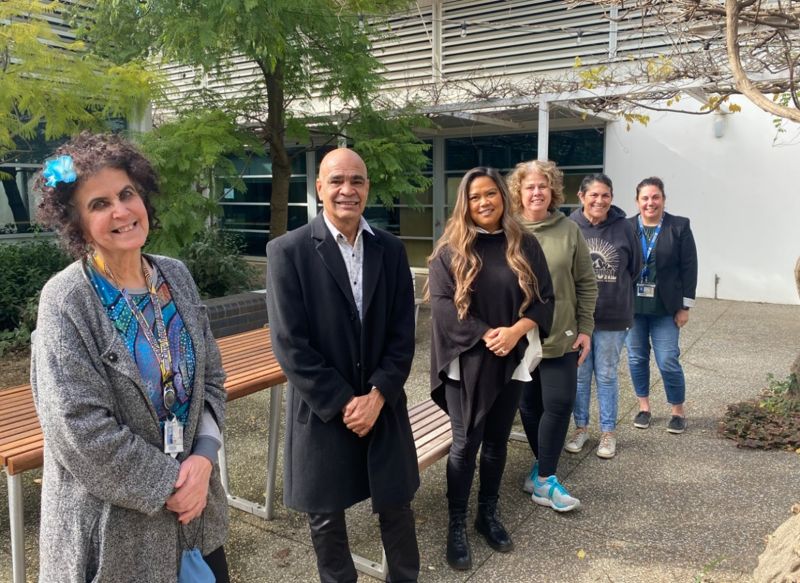
Specialist Certificate 2020 cohort: (L-R) Gwenda Freeman (Lecturer in Aboriginal Health Education, the University of Melbourne), Colin Mitchell (student), Chanoa Cooper (student), Helen Everist (student), Simone Guinan (student), Raylene Nixon (Lecturer in Rural Aboriginal Health, the University of Melbourne).
The first course in the pathway is the Specialist Certificate in Empowering Health in Aboriginal Communities. Students can enter this one-year, postgraduate course based on work experience rather than an undergraduate degree – a point of difference from traditional educational norms. Assistance with enrollment is provided and First Nations students can apply for a scholarship to cover university fees.
Students undertake a unique blend of online and in-person learning. Navigating two subjects in one year, each one requiring a week-long, face-to-face intensive (located in Shepparton, Victoria), accompanied by weekly readings, an online weekly tutorial and three written assessments. This hybrid learning approach not only facilitates a flexible educational experience but also empowers students to sustain full-time work, all within the familiarity of their hometowns and support of their communities— and without the need for uprooting and relocation, despite where they live.
Further, the coursework is not just academic; it's a platform for community wellness. From designing projects for Elders and youth to implementing initiatives for cancer survivors and babies, students are not just learning; they are actively contributing to the well-being of their communities.
In the initial subject, students are tasked with designing a project in their community and the second subject requires them to implement their planned project and bring their vision to life. Guided by First Nations academics from a strength-based perspective, students are also taught concepts in health, both cultural and biomedical approaches, as well as academic skills to prepare students for further educational success.
Following the Specialist Certificate, students can undertake another year to complete the Graduate Certificate in Aboriginal Health in Rural Communities, leading to the Master of Public Health (MPH) at the University of Melbourne, with a further twelve subjects undertaken. On completion of the MPH, students can then apply for the PhD program at the University of Melbourne with each step of the pathway supported by travel, academic assistance, and financial support.

Trailblazers: First Nations graduation celebration at the University of Melbourne Department of Rural Health. (L-R back row) Professor Julian Wright, Ms Andreia Marques, Ms Shawana Andrews, Ms Gwenda Freeman, Ms Helen Everist, Dr Karen Ferguson, Professor Dr Marcia Langton AO, Professor Lisa Bourke, Professor Doug Boyle, Professor John Prins.
(L-R front row) Dr Raylene Nixon, Ms Chanoa Cooper, Ms Leah Lindrea-Morrison, Ms Tracey Hearn and Dr Sharon Atkinson-Briggs.
The success stories are already emerging - sixteen graduates from the Specialist Certificate, seven from the MPH, four from the PhD and counting, with the majority from rural or remote regions. For every student completing one of these courses, career promotion and advancement or further study has resulted. The pathway has also seen a high rate of completion as well as health career and educational advancement.
This innovative First Nations pathway program isn't just an educational pathway. It demonstrates that by being responsive to the community, providing supported entry, educational support and financial investment, First Nations students living in rural and remote Australia excel in tertiary education. The pathway is rewriting the narrative, proving that by making opportunities possible, the outcomes are not just academic — they're a catalyst for career and educational advancement, with students gaining highly transferable postgraduate qualifications.
Authors
Lisa Bourke – Director, Department of Rural Health, University of Melbourne
Raylene Nixon - Indigenous Postdoctoral Fellow and Lecturer Rural Aboriginal Health, Department of Rural Health, University of Melbourne
Gwenda Freeman - Lecturer Rural Aboriginal Health, Department of Rural Health, University of Melbourne
Alice Pettit - Project Officer in Aboriginal Health – the Department of Rural Health, University of Melbourne
Kathy Lynch - UDRH Project Officer, Department of Rural Health, University of Melbourne
Giacinta Caione – Marketing and Communications Coordinator, Department of Rural Health, University of Melbourne
References
- McGagh J, Marsh H, Western M, Thomas P, Hastings A, Mihailova M, Wenham, M. Review of Australia's research training system: final report. Australian Council of Learned Academies (ACOLA); 2016. https://acola.org/research-training-system-review-saf13/
- Hearn S, Kenna L. Spending for success: Identifying ‘what works?’ for Indigenous student outcomes in Australian Universities. Aust J Indigenous Educ 2021; 50(2):237-246. Doi 10.1017jie.2020.27
This article appeared in the March edition of Partyline by National Rural Health Alliance: https://www.ruralhealth.org.au/partyline/article/empowering-first-nations-students-rural-australia