Health Service Environmental Sustainability Competition
The Sustainable Healthcare Team is excited to announce the launch of the 2026/27 University of Melbourne Health Service Environmental Sustainability Competition.
What is the Health Service Environmental Sustainability Competition?
The competition aims to foster engagement in sustainable healthcare quality improvement initiatives by providing support resources to catalyse impactful initiatives that improve quality of care, reduce emissions and waste, are financially viable, and continue to engage health organisations and staff.
Our Partners
- Royal Melbourne Hospital
- Peter MacCallum Cancer Centre
- Royal Women's Hospital
- Royal Children's Hospital
- Austin Health
- St Vincent's Hospital Melbourne
- Western Health
- Mercy Health
If you have any questions about the competition please contact Lindsay Scudder, Implementation Lead, at lindsay.scudder@unimelb.edu.au.
How to get involved?
Step 1: Read the Participant Information Pack for information on:
- Participation in the competition
- 2027 key dates
- Project registration
- The Sustainability in Quality Improvement Workshop on Wednesday July 1st 2026
- Our National Health and Medical Research Council (NHMRC) funded research project
Step 2: Register your project idea
You can also register your interest in the SusQI workshop and NHMRC research project via this form.
Step 3: Download the Competition Overview to learn about:
- Healthcare sustainability
- Sustainability in Quality Improvement
- The history of the competition
- Measuring environmental, financial and social impact
Step 4: Get guidance for your project
Once you have registered, your health service’s sustainability or clinical lead will contact you to support you with your project.
Step 5: Review these useful resources and tools
Step 6: Get going with your project!
Step 7: Populate Final Project Submission Form
Submit by March 24th 2027 to lindsay.scudder@unimelb.edu.au
Past Winners
-
Overall Winners
Best Emissions Reduction Project - Decommissioning reticulated nitrous oxide to reduce greenhouse gas emissions at RMH, by Tugce Ozturk, Engineering, Royal Melbourne Hospital.
Best Clinical Project - Discontinuing the use of disposable shoe covers in Operating Theatres by Dr Qi Rui Soh, Operating Theatres, Western Health.
Best Non-Clinical Project - Patient informed changes to default meals reduces annual food and packaging waste in a tertiary hospital by Aimee Dow, Food Services, Royal Melbourne Hospital.
Health Service Winners
Best Austin Health Project - SQuDs-ED (Sustainable and Quality use of Diagnostics in the ED) - Reducing VBG and IV cannulation by Liz Willliams and Celia Hall, Emergency Department.
Best Mercy Health Project - Diverting single use metal instruments from landfill by Joanna Milne, Sustainability Department.
Best Peter MacCallum Cancer Centre Project - Closing the Loop: A Circular Economy Model for Medical Equipment by Prem Krishnan, Biomedical Engineering.
Best Royal Children's Hospital Project - Rationalising the use of disposable pulse oximetry probes (d-POP) peri-operatively at the Royal Children's Hospital (RCH) by Poilin Howland, PACU.
Best Royal Melbourne Hospital Project -Gloves Off! Reducing inappropriate non-sterile glove use with a multi- modal strategy by Liz Orr, IPSS.
Best Royal Women's Hospital Project - Reprocessing DVT garments – promoting circular economy with industry by Seiko Etsue, Procurement and Facilities.
Best St Vincents Hospital Project - Choosing Wisely: Reducing unnecessary blood tests for General Medicine inpatients by Dr Anne Drake, General Medicine.
Best Western Health Project - Discontinuing the use of disposable shoe covers in Operating Theatres by Dr Qi Rui Soh, Operating Theatres, Western Health.
Entries
Projects
Department
Hospital
Waste reduction in ICU through repurposing of calf compressors.
Intensive Care
Austin Health
Antibiotic Vial Lid Recycling
Paediatrics
Austin Health
Right Bin, Right Place
Sustainability Unit
Austin Health
SQuDs-ED (Sustainable and Quality use of Diagnostics in the ED) - Reducing VBG and IV cannulation
Emergency Department
Austin Health
Diverting single use metal instruments from landfill
Sustainability
Mercy Health
Diverting waste from landfill using our centralised recycling station
Sustainability
Mercy Health
Closing the Loop: A Circular Economy Model for Medical Equipment
Biomedical Engineering
Peter MacCallum Cancer Centre
Medical Education
Royal Children's Hospital
From Waste to Worth: A Sustainable Shift in Haemodialysis Water Use
Nephrology/Haemodialysis
Royal Children's Hospital
Paediatric ICU
Royal Children's Hospital
Small Change, Big Impact: Removing Bluey Absorbent Liners from Emergency Care
Emergency Department
Royal Children's Hospital
Pharmacy
Royal Children's Hospital
Anaesthesia
Royal Children's Hospital
PACU
Royal Children's Hospital
Food waste recycling
Food Services
Royal Children's Hospital
RCH Kitchen Garden Program
Food Services
Royal Children's Hospital
Replacing disposable Pulse Oximetry probes with reusable in ED
Emergency Department
Royal Children's Hospital
Decommissioning reticulated nitrous oxide to reduce greenhouse gas emissions at RMH
Engineering
Royal Melbourne Hospital
Cut the Cannula
Emergency Department
Royal Melbourne Hospital
Patient informed changes to default meals reduces annual food and packaging waste in a tertiary hospital
Food Services
Royal Melbourne Hospital
Recirculation of unopened shelf-stable fluids
Food Services
Royal Melbourne Hospital
Rethinking Clinical Waste: A Safe, Cost Effective and Sustainable Waste Management Strategy at RMH
Infection Prevention
Royal Melbourne Hospital
Gloves Off! Reducing inappropriate non-sterile glove use with a multi- modal strategy
Infection Prevention
Royal Melbourne Hospital
Reprocessing DVT garments – promoting circular economy with industry
Procurement and Facilities
Royal Women's Hospital
Choosing Wisely: Reducing unnecessary blood tests for General Medicine inpatients
General Medicine
St Vincent's Hospital Melbourne
Ceasing use of single-use plastic water bottles in the Health Independence Program (HIP)
St Vincent's Hospital Melbourne
Reducing Food Waste
Food Services and Nutrition
St Vincent's Hospital Melbourne
Decommissioning of piped nitrous oxide project
Anaesthesia and Acute Pain Medicine
St Vincent's Hospital Melbourne
Discontinuing the use of disposable shoe covers in Operating Theatres
Operating Theatres
Western Health
Think outside the custard box
Sustainability
Western Health
Right Bin Right Waste – putting a lid on clinical waste
Intensive Care Unit
Western Health
Economic and Environmental Evaluation of polymeric locking clips in Laparoscopic Appendicectomy and Cholecystectomy
Operating Theatres
Western Health
-
Winners
Best emissions reduction
- Glove and gown disposal project by Arryn Garven and Lachlan Tait, Department of Intensive Care, Royal Melbourne Hospital
Best waste reduction
- Replacement of Disposable Pacemaker/ICD Implanting Instruments with Re-usable Pacemaker/ICD Implanting Instruments by Kate Welsh and Gareth Wynn, Cardiac Cath Lab, Royal Melbourne Hospital
Best clinical change project
- IV Fluid Reduction Strategies Reduce Overall Carbon Footprint by Daniel O’Brien, Department of Pharmacy, Royal Melbourne Hospitals.
Best non-clinical project
- Oral Nutrition Supplements (ONS) Reimagined: From Ward Return to Ward Resource by Belinda Steer, Food services Dept and Department of Allied Health, Peter MacCallum Cancer Centre
Best RMH project
- IV Fluid Reduction Strategies Reduce Overall Carbon Footprint by Daniel O’Brien, Department of Pharmacy, Royal Melbourne Hospitals.
Best PMCC project
- Repurposing Icepacks for Community Benefit by Marianna Corrales, Research and Pathology Labs, Peter MacCallum Cancer Centre
Best RWH project
- Reducing plastic speculums for gynaecological ultrasound procedures by Ying Gu, Department of Ultrasound Services, Royal Women’s Hospital
Entries
Projects Department Hospital Eliminating Triclosan use in PAC Thoracic Surgery RMH Reducing unnecessary TEDS use in surgical services Theatres RMH Reducing packaging waste from IT leasing Information Technology PMCC Reducing waste from unopened nutritional supplements Food services/Allied Health PMCC Reducing waste from discarded PPE in ICU ICU RMH Reusing ice packs for community benefit Research labs PMCC Eliminating unnecesary/wasteful labelling ofg medication Pharmacy PMCC Reducing unnecesary post op CXR in thoracic surgery Thoracic Surgery RMH Automation of accounts patable to reduce paper use Financial services RMH Reducing plastic speculum use Radiology RWH Eliminating single use pacemaker insertion instruments Cath Lab RMH Reducing unnecessary IV fluid use Pharmacy RMH Audit of recyclable waste from food services Food services RMH Paperless consent forms Radiology RWH -
Winners
Best Clinical Change Project
- Choosing Wisely in ED - reducing IV cannulation and CTPA by Fahad Youssef, RMH ED
Best Facilities Project
- Arjo Renu Program by Pauline Whittle, Procurement team
Best Waste Reduction Project
- Environmental Sustainability in Dermatology Research by Kate Scholtens and Melissa Markos, Dermatology Dept
Best ward project
- Sustainability resource board by Rachael Martin and Ward 3 West
Best emissions reduction project
- Virtual Spinal Fracture Clinic by Emily Cross, Telehealth team and orthopaedic team
Entries
Projects Department Hospital Reducing unnecessary IV cannulation and CTPA Emergency Dept RMH Sustainability resource board Endoscopy RMH Allied Health goes pagerless Allied Health RMH QR Patient information sheets Ward 6SE RMH Reducing unnecessary COAG pathology orders in preadmissions clinic Theatres RMH Electronic contracting Workforce RMH Minimising food waste from swallow tests Food services RMH Introducing reusable hover mats - Arjo Renu project Procurement RMH Minimising waste in dermatology Dermatology RMH Reducing the impact of blueys when weighing newborns across maternity Maternity RWH Spine Virtual Fracture Clinic Orthopaedic surgery RMH Minimising waste from patient hygiene items in ICU ICU RMH Reusing soft plastics for cushions Clinical Assistants RMH Changing to reusable drug trays Theatres PMCC Eliminating nitrous oxide use Theatres PMCC -
Winners
Best Clinical Change Project
- Choosing Wisely in ED - reducing blood gases and coagulation testing by Fahad Youssef, RMH ED
Best Facilities Project
- Zero Emissions Fleet Vehicles for RMH by
Nathaniel Sneddon, Facilities team
Best Waste Reduction Project
- Greener Procurement Project by Pauline Whittle, Procurement team
Best Ward Project
- Ward 8B Sustainability Teams by Andrea Wu and Ward 8B
Best Emissions Reduction
- RMH telehealth expansion by Barbara Ioppi and the RMH Telehealth Team
Entries
Projects Department Hospital Reducing unnecessary ABGs and Coags in ED Emergency Dept RMH Clinical waste education video Sustainability team RMH Audit of nitrous oxide use Theatres RMH Zero emission fleet vehicles Facilities RMH Reusable face shields and goggles Procurement RMH LED lighting switch Facilities RMH Paper free Mental Health Triage Mental Health RMH Paperless Revenue Services Revenue Services RMH Operating Theatre sharps bin audit Theatres RMH Ward sustainability teams Ward 8B RMH Dermatology research kit recycling project Dermatology Research RMH Paper-free environmental services Environmental Services RMH RMH telehealth expansion Telehealth RMH Reducing unnecessary pathology and CXRs in cardiothoracic preadmission clinic Cardiothoracic surgery RMH
Example Entries
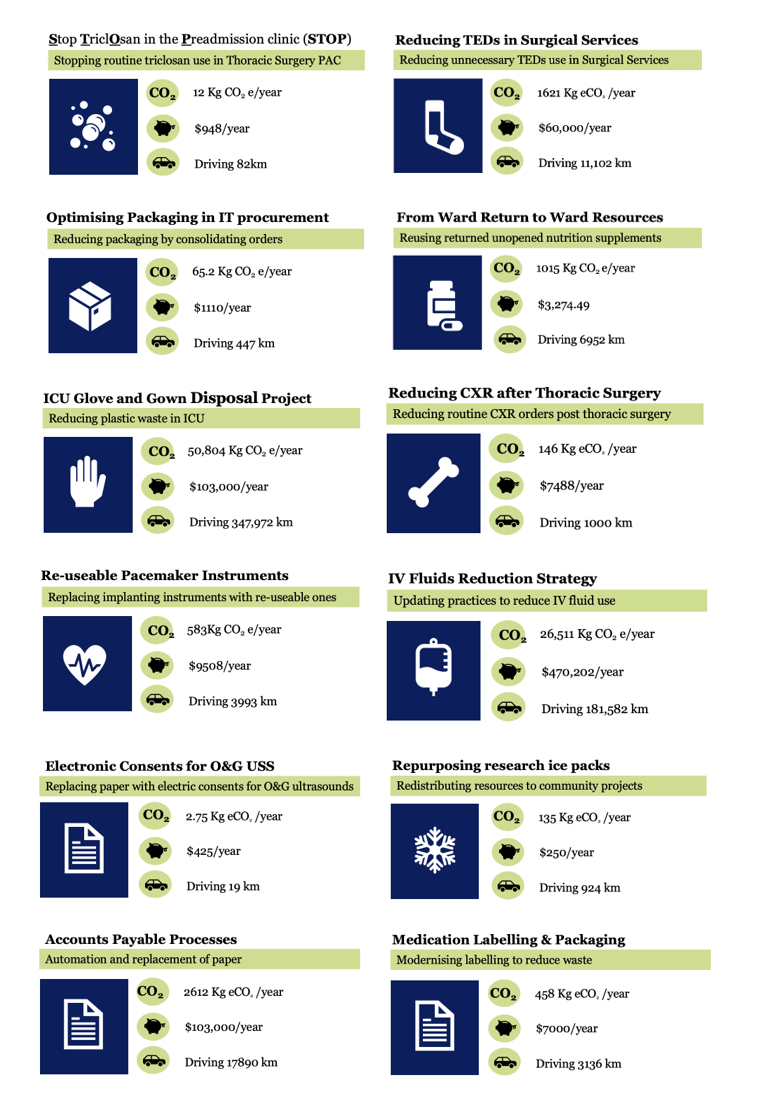


Environmental sustainability competitions: Engaging healthcare staff in sustainable and financially beneficial initiatives
Asia Pacific Journal of Health Management, August 2025
Authors: Chanchlani, Sonia, Shi, Jenny, Allman, Jacqueline, Page, Monika, Purushothaman, Gily, O’Shaughnessy, Vanessa, Manihar, Rajesh, Kayak, Eugenie, Dunne, Ben
