The University of Melbourne has become Victoria’s first beacon site for Sustainable Quality Improvement (SusQI) in healthcare.
Australia’s healthcare system is responsible for about 7 per cent of the nation’s carbon emissions — that’s around half the emissions created by the construction sector — with hospitals generating the largest proportion.
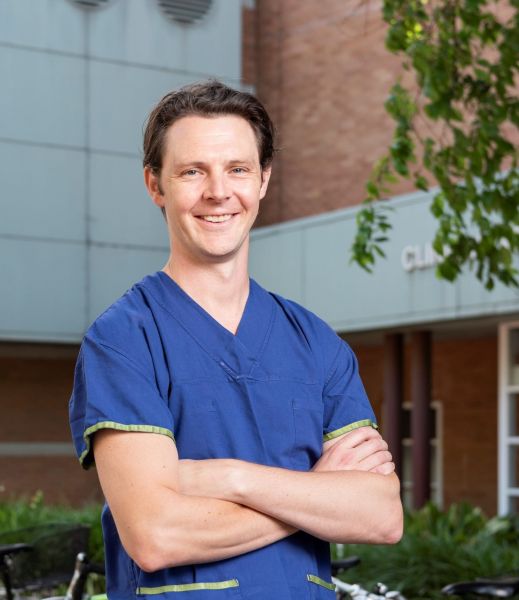
Delivering safe and effective healthcare with low environmental and financial costs is a priority for the University of Melbourne’s Environmentally Sustainable Surgery Network, led by Dr Ben Dunne, a thoracic surgeon and Royal Melbourne Hospital Clinical Sustainability Lead.
“Sustainability has been an interest for me since 2019,” says Dr Dunne. “I became more aware [that] what we did delivering care day-to-day was a significant contributor to climate change. Increasing data and science around the problem, combined with the striking visual encounters with waste generation over the pandemic, amplified the issue for me.”
The Network is a surgeon-driven initiative, with surgeons from a number of University-affiliated hospitals coming together to collaborate on how surgical care delivery can be more environmentally efficient.
To drive this change, Dr Dunne is collaborating with colleagues across the faculty, including Associate Professor Forbes McGain OAM (MBBS 1996, GDipPeriopCritCareEcho, PhD 2016), Associate Dean of Healthcare Sustainability, Dr Sonia Chanchlani, Senior Fellow in Climate Health and Sustainability, and Professor Eugenie Kayak (BSc (Hons) 1989, MSci (BioChem) 1995), Enterprise Professor in Sustainable Healthcare at Melbourne Medical School.
Thanks to work by Dr Chanchlani, the University has also been recognised as Victoria’s first SusQI beacon site by the Centre for Sustainable Health Care in the UK, a world-leading centre for sustainable healthcare research and practice. As a beacon site, the University is recognised as integrating environmental sustainability into the way students and health professionals are educated and trained.
There is certainly more awareness among students and junior doctors and they have great enthusiasm to learn, research and act, says Dr Dunne.
Students are also advocating for the change they want to see. “For the first time in Australia, Melbourne Medical School students, with the support of Doctors for the Environment Australia, participated in the Planetary Health Report Card (PHRC) project,” says Dr Dunne.
The PHRC reports on five key areas: curriculum, interdisciplinary research in health and environment, community outreach and advocacy, support for student-led initiatives, and campus sustainability. Each category is awarded a grade between A and F.
The University received an overall score of B minus and is now working towards implementing recommendations from the report.
“For the past two years, our MD1 and MD2 students have been able to learn about climate change and health and sustainability and healthcare as Discovery subjects,” says Dr Dunne.
“For our MD3 and MD4 students, there is now an option to do a clinical or research scholar pathway in sustainable healthcare through Royal Melbourne Hospital. This gives students a better understanding of how climate change will impact various diseases and presentations. We will also be teaching them how to run sustainable quality improvement projects in the healthcare setting.”
Read more about how MMS is tackling healthcare sustainability: pursuit.unimelb.edu.au