Dr Joanne Ngeow, a Senior Consultant in Medical Oncology at the National Cancer Centre Singapore, is a firm believer in the power of the alumni community.
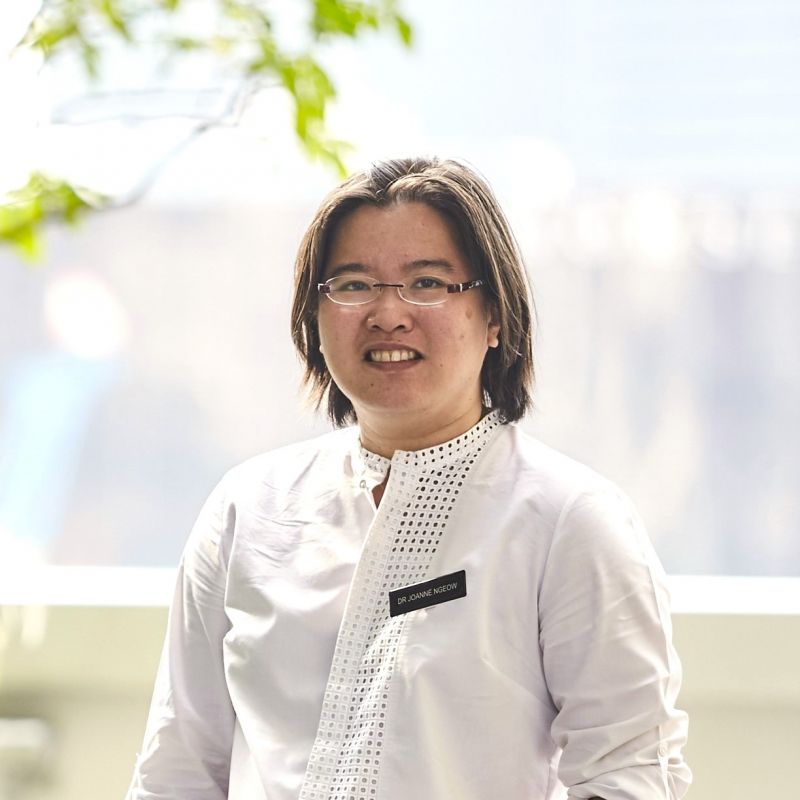
When Dr Joanne Ngeow (MBBS 2000 (Hons), BMedSci 2000) moved from Singapore to study at Melbourne Medical School, she discovered a passion for research that continues today.
“I credit that one year of student research with the fact that I am now a clinician-scientist,” says Dr Ngeow.
She studied the health issues faced by newly arrived African refugees in Melbourne. “It was an incredibly powerful experience because, at the time, Vietnamese and African refugees were getting a disease where they would present with a rash and sometimes jaundice and diarrhoea. GPs didn’t know what was causing it and sometimes those patients were wrongly given steroids which made their situation even worse,” says Dr Ngeow.
Her research identified the presence of past infections of a worm — strongyloidiasis — which is endemic in South-East Asia and parts of Africa. Dr Ngeow’s work on the prevalence of strongyloidiasis and infectious diseases among newly arrived refugees and migrants had significant impact, helping inform the government’s first refugee health guidelines.
“While at MMS, I remember being inspired by people like Graham Brown and Gustav Nossal, who told stories of public health and of doing things for the public good. That has remained with me,” recalls Dr Ngeow.
In 2001, Dr Ngeow returned to Singapore, keen to pursue a career as a clinician-scientist and to work for the ‘public good’. She moved into oncology and explored cancer epidemiology and genetics. This led to her founding the Cancer Genetics Service (CGS) at the National Cancer Centre Singapore.
“The CGS has done a lot to address the data gap in Asian genomics. Data from our research is being used by policymakers in Singapore and will be assessed for wider implementation to shift policy and how we deliver precision cancer care. We are working towards more equitable and accessible care through the use of genomics and digital technology,” she says.
Alongside her professional commitments — she is also Associate Professor of Genomic Medicine at Lee Kong Chian School of Medicine, Nanyang Technological University — Dr Ngeow has proactively built lasting connections between MMS alumni in Singapore and Malaysia and those working further afield.
My cohort have been part of a chat group for more than a decade and I’ve organised social activities to keep people connected. When anyone from our cohort visits Singapore we meet up, and it will be our 25th anniversary next year, so I will be reaching out to alumni to celebrate that, says Dr Ngeow.
The cohort is spread across America, the UK, Europe, Asia and Australia and Dr Ngeow says being part of a global alumni network brings social and practical benefits.
“It’s potentially good for professional collaborations. For example, recently a friend in Singapore wanted to learn more about a new emergency response program at the Austin Hospital in Melbourne,” she says.
“They knew I went to the University of Melbourne and asked if I knew anyone involved with the Austin program — they wanted to send a delegation to Melbourne to learn more about it. I put that request in our cohort chat group and someone connected me to the right person at the Austin and that has led to a useful collaboration. Such networks also allow us to mentor newly minted MMS graduates in Singapore and Malaysia.”
Stay connected to the alumni community: unimelb.edu.au/alumni