The popular Teddy Bear Hospital helps medical, dental, nursing and allied health students begin to understand the nuances of working with children.
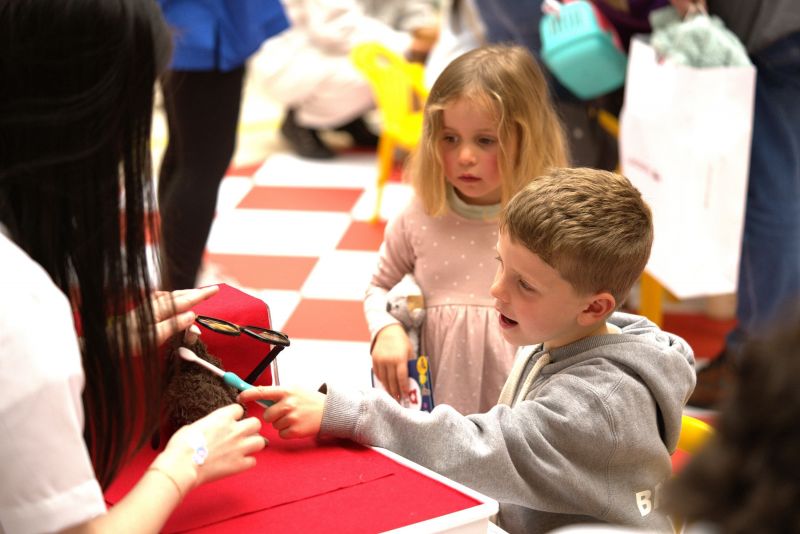
The Teddy Bear Hospital attracts some very special patients — ‘sick’ teddies, dolls and soft toys who are brought for a check-up by their young owners. The hospital staff are University of Melbourne students completing health courses ranging from medicine, physiotherapy and optometry to dentistry, nursing and speech pathology.
The ‘patients’ might have a teddy check-up or a teddy ECG or learn the skill of teddy toothbrushing — all while their young carers watch, listen and build trust with the treating student volunteer.
The Teddy Bear Hospital began in 2009 and is run by University of Melbourne students with the support of the University’s Department of Paediatrics.
The program consists of two events, the Teddy Bear Hospital Good Friday Appeal and the Chadstone Teddy Winter Check- Up, and provides children with positive healthcare experiences.
It is also an opportunity for students to practise their skills in working with children. They learn how to build rapport, use child-friendly language and practise giving information about the ‘patient’s’ condition in a way that children can understand.
The Teddy Bear Hospital Good Friday Appeal event at Melbourne Convention and Exhibition Centre in March attracted 1300 students and almost 5000 children. The Chadstone event attracts around 2000 children.
Brian Hao (BBiomed 2016) is a final year Doctor of Medicine student and he’s been a Teddy Bear Hospital volunteer and is on the event organising committee.
It’s a good way to give back to the community and to practise interacting with children in a low-pressure setting. While we have placement opportunities, we may not get as much time to speak to children during those placements, so the Teddy Bear Hospital is an opportunity to do that says Mr Hao.
“Kids are often quite shy at first, but they gradually open up and it’s very fulfilling when they give you a smile for the first time. Making children feel comfortable and helping them understand about their healthcare is a skill that’s not to be underestimated.”
Read more about the Teddy Bear Hospital: teddybearhospital.unimelb.edu.au