CARISTA | News & Events
We had a fantastic response from the public in 2025, and we are now inviting adults with hay fever and/or asthma for the 2026 season.
As grass pollen season is here, it’s time to get in early and contribute to this research.
If you’d like to participate then please register your interest!
Our Apology: Email Notification Error
We sincerely apologise for an error that occurred overnight on Wednesday 30 September 2026, which resulted in participants receiving numerous duplicate copies of our email regarding daily reports for the upcoming allergy season. We understand this was a frustrating and confusing experience, and we are sorry for the inconvenience this has caused our participants.
The issue affected only participants who took part in the 2025 allergy season. We want to reassure you that this was strictly a technical error related to how the emails were sent, and at no point was personal data or survey responses compromised. Participants' privacy has not been breached, and study data remains secure and confidential, accessible only to the authorised CARISTA research team.
The cause of the issue was a malfunction within REDCap, the secure data collection platform we use to manage the CARISTA study. A fault in the automated reminder system caused the email to be sent repeatedly rather than just once.
We have since identified and corrected the issue by reconfiguring the REDCap component responsible for scheduling and sending CARISTA emails. We have also implemented additional checks to help prevent this type of error from happening again.
We truly value everyone's participation in CARISTA and appreciate their understanding as we resolved this matter.
If you would like to discuss this issue further, or if you have any questions or concerns, please do not hesitate to contact us at carista-study@unimelb.edu.au or by phone at 0481 058 063 (CARISTA Study phone).
Thank you again for your patience and continued involvement in this study.
With sincere apologies,
Prof Jo Douglass AO MBBS FRACP MD
Co-ordinating Principal Investigator - CARISTA Study
James Stewart Chair of Medicine
Melbourne Medical School
The University of Melbourne
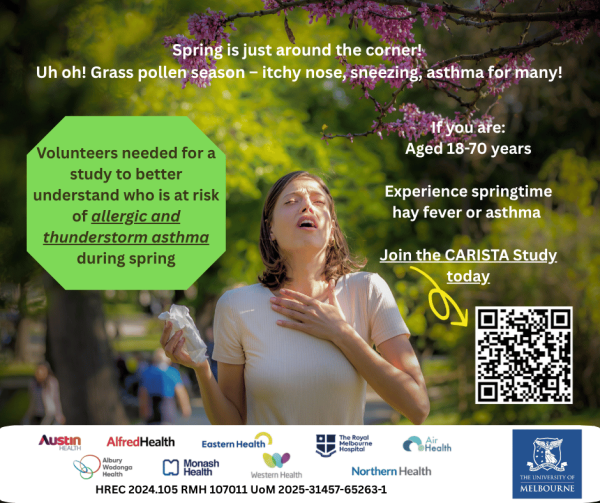
Progress update
The CARISTA Study launched in September 2025.
We are very excited to have spoken with >600 people since then and 445 are participating in our study!
We are aiming to include 590 people, so please register your interest and we warmly welcome your participation.

We are the CARISTA team at Albury Wodonga Health!
On 6 November 2024, our Emergency Departments experienced a significant thunderstorm asthma event. It saw record numbers of patient presentations to both of our Emergency Departments with asthma and breathing difficulties. Our regional health service has a wide catchment that includes farm and grasslands, and during the evening of 6 November 2024, thunderstorms and pollen conditions triggered a surge in asthma presentations to ED. Joanna, Karen and Bree work in Albury and Wodonga Emergency Departments.
In 2025, the Victorian Department of Health installed a pollen counter on the roof of Wodonga Hospital to hopefully predict another possible thunderstorm asthma event. This has also helped to establish optimal times for blood sampling our participants in the CARISTA study.
Albury Wodonga Health has a small, but committed research team, who are dedicated to improving care to patients and are excited to see outcomes from the CARISTA study.
This is the first time that the ED has collaborated with Melbourne University and Royal Melbourne Hospital, and we hope that this is the first of many joint projects.
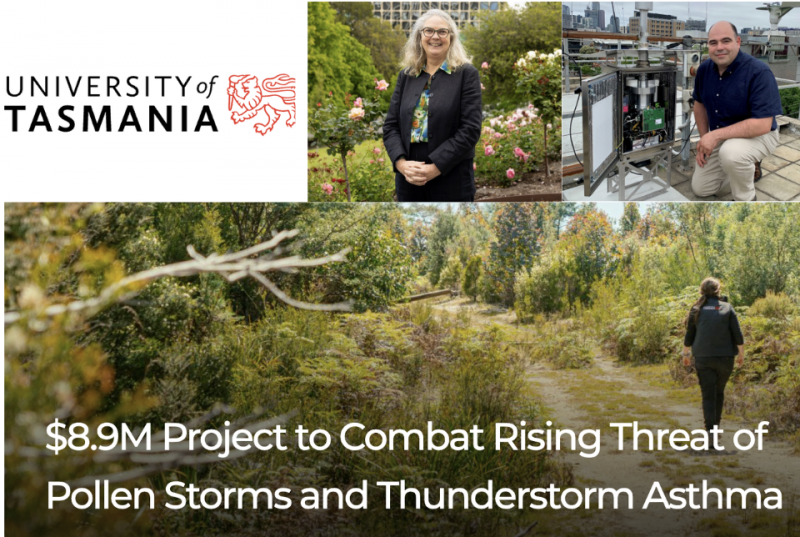
Researchers at Menzies are leading a project valued at over $8.9 million to significantly boost the national pollen monitoring network to help prevent deadly thunderstorm asthma events as climate change intensifies allergen risks.

Professor Jo Douglass from the University of Melbourne and asthma patient Liz talk to News Breakfast about CARISTA, a new research trial that could help identify risk indicators through a simple blood test for asthma and seasonal allergies
Nightlife Health - Hayfever
Spring means warmer weather, longer days and the inevitable bouts of hayfever. Blooming plants with their pollen are hay fever sufferers' kryptonite.
And although it can be very frustrating, with watering eyes and an itchy nose, this time of year can trigger a condition much more serious, thunderstorm asthma.
Dr Rachel Tham, an environmental epidemiologist and researcher at the University of Melbourne, whose work focuses on hayfever, asthma, aeroallergens, and air quality, discusses with Philip Clark why some experience allergic and thunderstorm asthma.
Professor Jo Douglass was on ABC talking about thuderstom asthma and hayfever. Click on the link below to learn more!