By Professor John Hamilton FAA (BSc 1963, PhD 1968, DSc 1990) and Associate Professor Tracy Putoczki
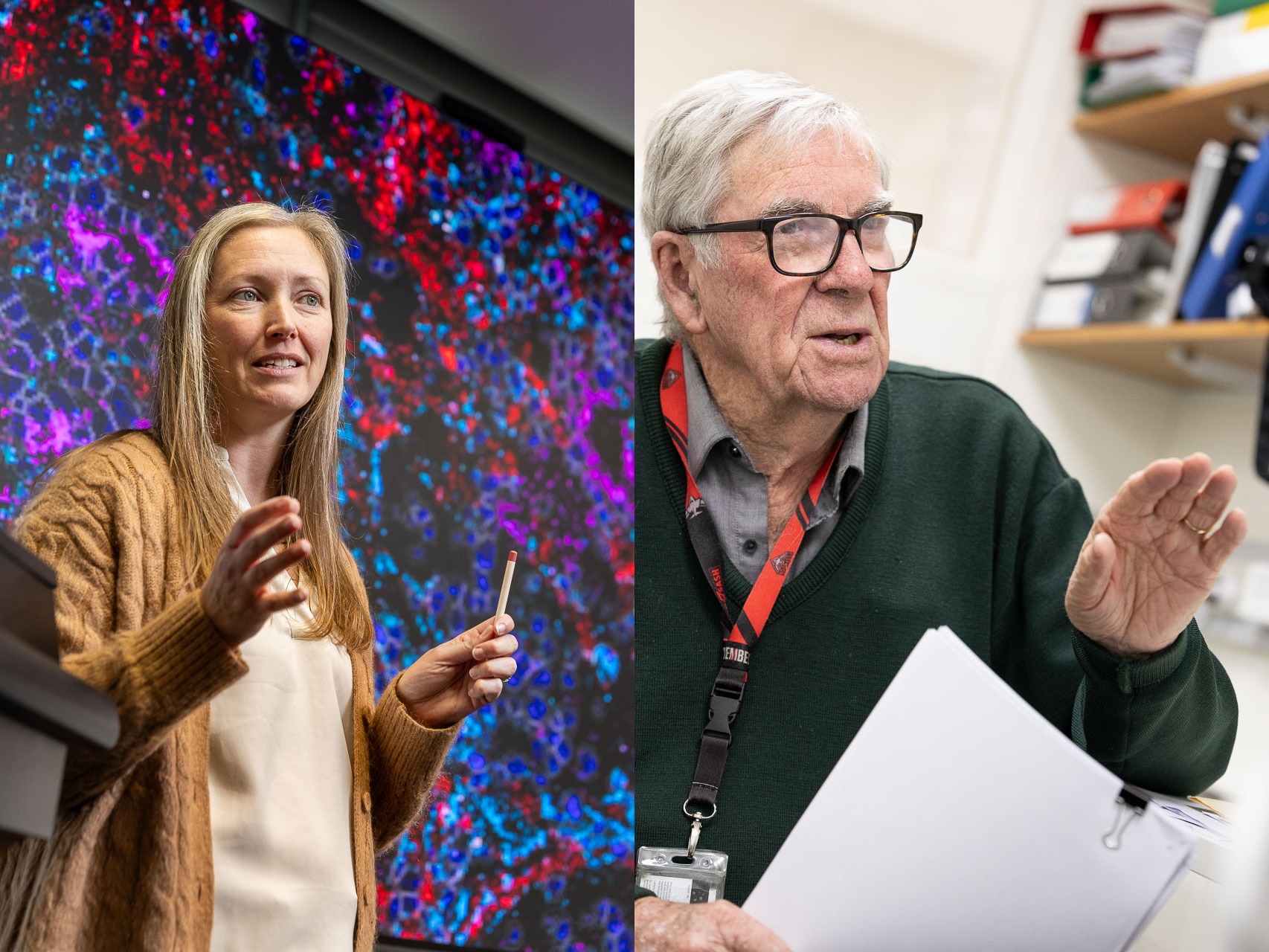
Right: Alum Professor John Hamilton explains a topic in an office room at the Department of Medicine, Royal Melbourne Hospital. Credit: Peter Casamento
From arthritis in our joints, inflammatory bowel disease and psoriasis, to cancer and heart and brain diseases, chronic inflammation is making us sick. Yet it’s one of the least understood drivers of disease. Why is the body’s own healing mechanism causing such harm?
Researchers are only just starting to piece together the underlying mechanisms. But new technologies could hold the key to understanding why the body struggles to regulate its powerful immune system, why persistent inflammation strikes and how to detect and treat it early – opening possibilities for curing chronic disease.
Most of us know inflammation as the body’s short-term response to infection or injury. It’s the immune system springing into action, sending reinforcements to fight off invaders or to begin the healing process. In this context, inflammation is not only normal – it’s essential. But when inflammation is prolonged or misdirected, it becomes increasingly destructive.




This idea is not new. When Melbourne hosted the Seventh World Congress on Inflammation in 2005, the central theme was ‘Inflammation, the key to much pathology’. This recognised that tackling inflammation requires system transformation in how we approach healthcare, moving beyond silos to integrated, cross-disciplinary models.
Of course, our evidence-based knowledge has progressed. The conceptual framework, I3 – infection, immunity and inflammation – has emerged to describe how insults to the body can trigger self-sustaining inflammatory loops. These loops underlie a growing number of diseases that collectively represent the leading causes of disability and mortality worldwide, such as cardiovascular disease, chronic kidney disease, fatty liver disease, type 2 diabetes and neurodegenerative diseases like Alzheimer’s disease and Parkinson’s disease.
In all these conditions, the body identifies something abnormal and tries to get rid of it.
Newly understood causes of chronic inflammation
Pathogens, like bacteria and viruses, used to take most of the blame for triggering inflammation. Long COVID brought renewed focus to the long-term effects of viral exposure. Recent research has indicated that inflammation is associated with almost every human disease. It has also shown that inflammation can be triggered by cells that monitor for tissue stress and malfunction, and that molecules participating in the inflammatory process play a role in restoring normal homeostasis.
Accordingly, inflammation can be defined as an immune response to potentially harmful stimuli or perturbations – such as injury or metabolic stress – in addition to pathogens. In other words, emerging research is uncovering a wider spectrum of triggers beyond pathogens, including modifiable factors that we can control.
However, many of the triggers and their impacts on inflammation-associated diseases will need to be defined by further research.


How does inflammation work?
Understanding how all these factors converge is one of medicine’s great challenges.
We are only just beginning to understand how disturbances in one system – like the gut – can spark inflammatory responses in entirely different organs including the heart and brain. Rather than thinking of these organs in isolation, researchers now view inflammation as a dynamic, cross-system conversation among immune cells, tissues and microbial communities.
This shift is driving more interdisciplinary research into common mechanisms across diseases. For example, studies of the gut–brain axis are revealing how inflammatory signals in the digestive tract can influence neurological conditions, linking gastroenterology and neuroscience in new ways.
From this idea of a coordinated network of cellular communication spanning the body, a powerful metaphor is emerging: inflammation as a ‘city’. Different cell types form ‘neighbourhoods’, immune pathways act as ‘roads’ and signalling molecules serve as ‘traffic lights’, controlling when cells activate or shut down.
Until recently, we lacked even a basic street map. Now, researchers are starting to uncover the underlying infrastructure and gaining a better understanding of how it functions as a whole –what might cause, say, a red light to turn green.
Our city-wide view helps explain why common mechanisms are found across seemingly unrelated conditions. Inflammatory diseases like rheumatoid arthritis, inflammatory bowel disease and psoriasis share key molecular pathways. When certain signals go awry in one part of the ‘city’, disruption can occur in a variety of other places. In other words, different diseases are caused by a shared underlying dysfunction.
Where will breakthroughs come from?
The future of inflammation research will depend on greater integration – not just across disciplines, but also across populations. We need diverse patient representation in studies so we can stratify data to better reflect gender, genetic and environmental differences.
We also see great potential in advanced analytical techniques like spatial biology, which allow scientists to see which cells are active, and where and how they interact with the cells around them. At the same time, computational analysis will allow researchers to process enormous datasets from large numbers of patients.
Combining model systems, patient samples and clinical data could pave the way for innovative therapies to disrupt the inflammatory process. The more we learn about the molecular conversations driving inflammation, the more opportunities we will have to develop cross-cutting treatments that address the root cause.
Another avenue of enquiry is to identify early-stage biomarkers that can be detected by non-invasive screening. Right now, our ability to catch conditions like colorectal cancer early can dramatically improve patient outcomes. One day, we hope the same will be true for a host of other inflammatory-driven diseases for which we currently have no early screening options.
With better data, more diverse population studies and new technologies, the landscape of inflammation will be revealed – and with it the possibility of game-changing early intervention in some of our most devastating diseases. The goal is not only treatment, but curing chronic disease through earlier detection, broader prevention, and therapies that address root causes.
Help shape the future of inflammatory disease research, care and treatment.
Find out how you can support our researchers and students.