Mapping Brainstem Analgesic Circuits with 7T fMRI
University of Sydney researcher and MBCIU collaborator Dr. Lewis Crawford has published a paper in Science titled “Somatotopic organization of brainstem analgesic circuitry.” (Read the full paper here.)
The study examined how the periaqueductal gray (PAG) and rostral ventromedial medulla (RVM), two key brainstem regions involved in descending pain modulation, respond when pain is experienced in different parts of the body.
In a cohort of 93 healthy participants, controlled heat pain was applied to the face, arm, and leg while brainstem activity was measured with high-resolution 7 T fMRI at the Melbourne Brain Centre Imaging Unit (MBCIU). Placebo cream and stimulus modulation were used to engage the brain’s natural analgesic system. Because the PAG and RVM clusters are only 1–2 mm wide, ultra-high-field MRI was essential to detect signal changes within these small regions.
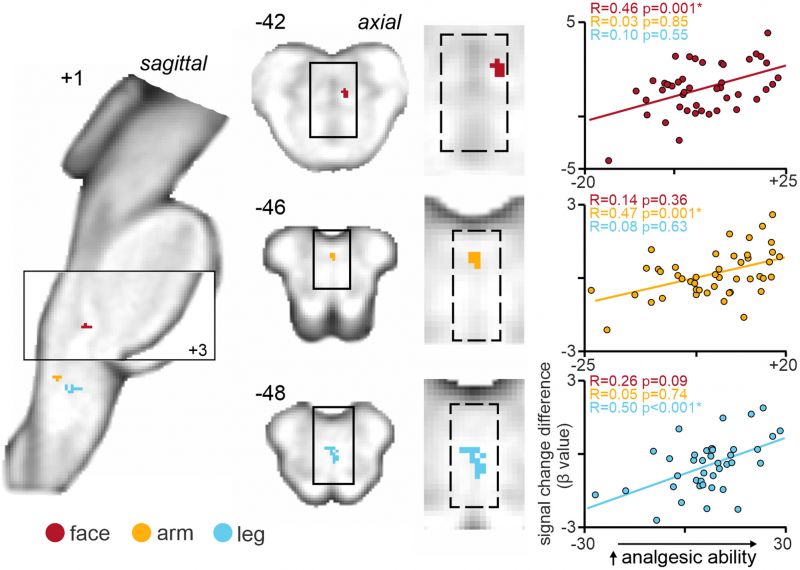
The study found that analgesic responses were spatially organised: activation within the PAG and RVM was restricted to the areas corresponding to the stimulated body region. These findings provide a detailed scheme for the organisation of pain control in the brainstem, offering new insight into the anatomical specificity of placebo analgesia and suggesting possibilities for more targeted approaches to pain management.
The MBCIU is proud to have enabled this research through access to our 7 T MRI and technical expertise. Such specialised imaging capacity is essential for detecting subtle yet meaningful patterns in the brainstem, and for supporting research that could have long-term implications for understanding and treating pain.
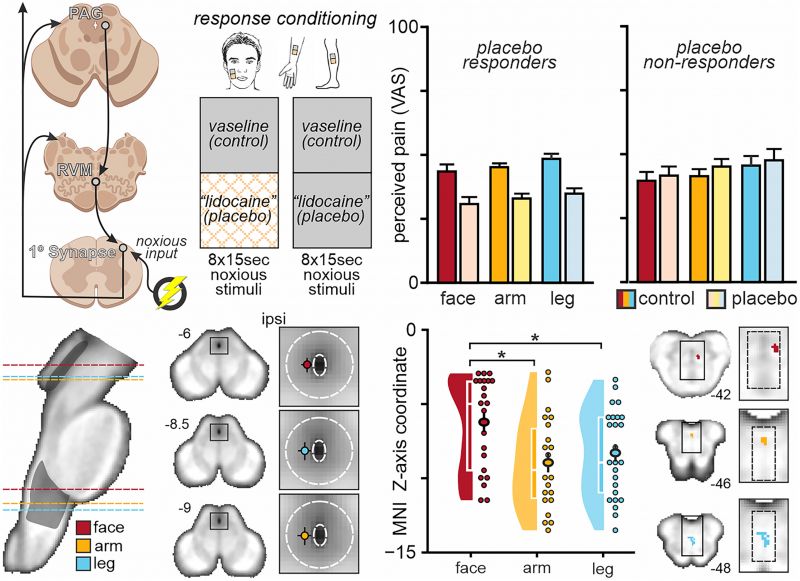 Lewis S. Crawford et al., Somatotopic organization of brainstem analgesic circuitry. Science 389, eadu8846 (2025). DOI: 10.1126/science.adu8846