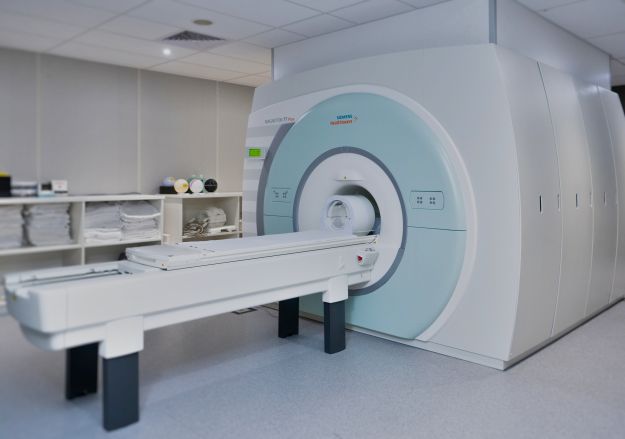
Siemens 7 Tesla MRI Scanner
Our Siemens Magnetom 7T Plus Ultra High Field Magnetic Resonance Imaging scanner is one of only two in Australia. This state of the art scanner provides unprecedented image quality allowing acquisition of non-invasive structural, functional and molecular information at exquisite spatial and temporal resolutions.
The 7T MRI scanner was purchased from Siemens and installed on the ground floor of the Melbourne Brain Centre at Parkville in March 2014. The MBCIU has a Master Research Agreement with Siemens that allows the latest MRI technology to be available on the scanner for research collaborators before they are commercially available.
Research studies on the 7T continue to be primarily neuroimaging focused, however the node has expanded applications with an increase of non-brain studies, given exemplary new functionality with the eye and cervical spine coils, and the flexibility of the knee coil to study wrists and other peripheral limb sections.
The facility maintains world’s best practice for the following applications and expertise:
- Quantitative structural MRI
- Spectroscopy Imaging
- Quantitative Susceptibility Mapping (QSM)
- Sodium MRI
- Neuro-Vascular Imaging (Time of Flight and SWI)
- Functional MRI (fMRI)
- Ultra-high field MRI Safety (Accredited MRI safety officer and expert)
The MBCIU is the University of Melbourne Node of the National Imaging Facility (NIF, https://anif.org.au/). This facility has funded the purchase and operations of the Human 7T MRI and PET/CT scanners via the Australian Government NCRIS program, and Victorian Government matching funds. The purpose was to provide Australian scientists with world-class neuroimaging facilities.
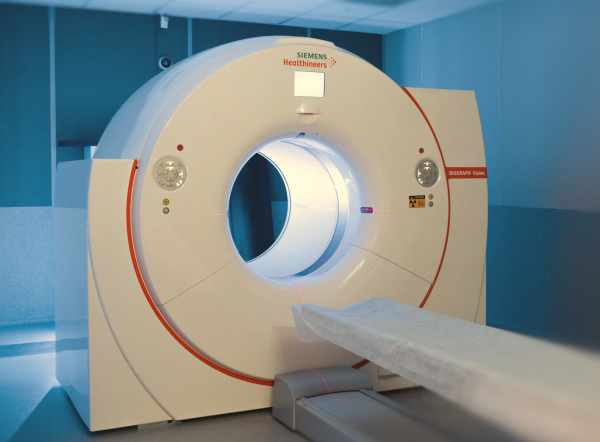
Siemens PET-CT Scanner
The Imaging Unit within the Melbourne Brain Centre at Parkville houses a state-of-the-art PET-CT scanner, which has been funded under the umbrella of a successful VSA bid submitted by the Victorian Biomedical Imaging Consortium (VBIC). Radiopharmaceuticals can be scanned in order to study tissue function and metabolism and novel biomarkers are being used to study brain disorders such as Alzheimer's disease. The system can provide time-of-flight measurements and has an extended field of view PET with 128-slice CT.
The Human PET/CT has continued to be well utilised in a broad range of research studies and clinical trials. Optimised reconstruction is developing as a focus for the UOM PET/CT team, using dedicated access to the Siemens e7 toolbox, and in collaboration with CSIRO for standardised tracer uptake computation. A primary objective of this work is to derive metrics by which to evaluate scanner harmonisation in multicentre studies.
OPM-MEG
The Optically Pumped Magnetometer Magnetoencephalography (OPM-MEG) system, funded by ARC LIEF, was procured and installed in 2024. It is the first OPM-MEG system in the Southern Hemisphere and forms part of the MBCIU at the University of Melbourne, giving researchers access to an unparalleled suite of imaging technology for structural and functional brain research, all within at single world-class facility.
MEG enables continuous recordings of ongoing brain activity with millisecond-level temporal resolution. OPM-MEG uses small, lightweight sensors that operate at room temperature and can be positioned close to the scalp, enhancing both signal strength and spatial resolution. This wearable and flexible configuration enables the recording of brain activity during naturalistic and interactive conditions, including movement, speech, and sensory tasks, enabling the study of cognition and brain function in more ecologically valid settings. OPM-MEG is non-invasive and well suited for research in neurological, psychiatric, or movement disorders.
The system includes 50 Field Line OPM sensors, which can operate as 50 single-axial sensors or be configured to form 100 dual-axial or up to 150 tri-axial channels. This technology can be used to investigate auditory and visual processing, cerebellar activity, neurobiological markers in psychotic disorders, and the development of next-generation brain–computer interfaces.
The peripheral OPM-MEG equipment include:
- ProPixx visual projector (1440 Hz refresh rate)
- SOUNDPixx auditory stimulation
- RESPONSEPixx /MRI Dual handheld 5-button fiber-optic response box
- Stimulus delivery computer (Psychtoolbox and PsychoPy)

The Melbourne Brain Centre Imaging Unit at the University of Melbourne is a Partner of the National Imaging Facility, a National Collaborative Research Infrastructure Strategy (NCRIS) capability.