About Us
About the Centre for Excellence in Rural Sexual Health (CERSH)
Funded by the Victorian Government Department of Health through a service agreement with The University of Melbourne, our program sits within the Department of Rural Health in the Faculty of Medicine, Dentistry and Health Sciences at Shepparton, Parkville and Wangaratta campuses. We also have a partnership with La Trobe University Bendigo campus, where our Loddon Mallee staff are located.
What we do
Improving rural sexual and reproductive health is at the heart of our mission. We design, implement and evaluate programs that deliver practical, targeted solutions to sexual and reproductive health challenges in the Hume and Loddon Mallee regions.
Guided by community development principles, we prioritise building local capacity by co-designing solutions that address issues where they arise. The evidence we generate informs best practices and drives service system improvements across broader settings.
While our core focus remains on these two specific regions, we extend our reach through an online platform, offering no-cost, reliable information and resources.
Collaboration is fundamental to our approach. We initiate and sustain strong partnerships with key agencies, networks and individuals to prevent duplication, enhance impact and create lasting, meaningful change.
Meet the team
Professor Jane Tomnay AM
Director, CERSH
jane.tomnay@unimelb.edu.au
Anne-Marie Kelly
Deputy Director, CERSH
annemarie.kelly@unimelb.edu.au
Associate Professor Siobhan Bourke
Sexual Health Physician/Senior Lecturer
siobhan.bourke@unimelb.edu.au
Kim Cowen
STI-X Project Coordinator
kim.cowen@unimelb.edu.au
Ashleigh Colquhoun
Sexual Health and Wellbeing Project Lead
a.colquhoun@unimelb.edu.au
Chloe Quinlivan
Strategic Communications and Engagement Coordinator
chloe.quinlivan@unimelb.edu.au
Kate Toomey
Sexual and Reproductive Health Project Officer
kate.toomey@unimelb.edu.au
Olivia Gray
Sexual and Reproductive Health and Wellbeing Project Officer
gray.o@unimelb.edu.au
Sophie Stuart
Sexual Health MD Discovery Coordinator and CERSH Centre Coordinator
sophie.stuart@unimelb.edu.au
cersh-admin@unimelb.edu.au
Strategic plan
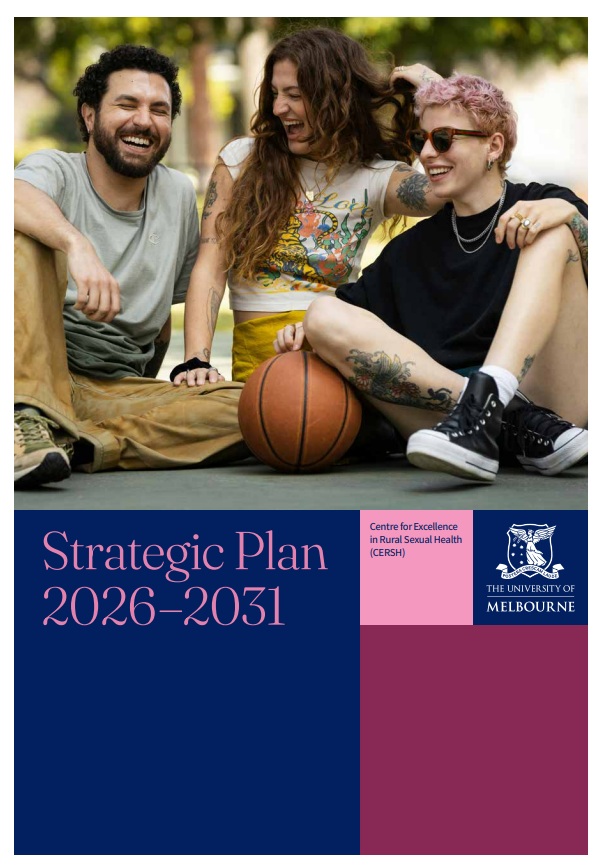
The CERSH 2026-2031 Strategic Plan outlines our vision and priorities for the next five years.
-
Empowered rural Victorian communities with equitable access to high quality sexual and reproductive healthcare, support and information.
-
To improve sexual and reproductive health and wellbeing for all rural Victorians through workforce development, collaboration and sustainable, community-led solutions.
-
- Young people
- Aboriginal people
- Lesbian, gay, bisexual, transgender, intersex,
queer and asexual+ (LGBTIQA+) people - Culturally diverse communities
-
- Excellence in rural workforce development
- Impactful collaborations and networks
- Innovative, practical and community-centred initiatives
- Trusted leadership and responsive support, including research capacity building
Annual reports and strategic plans
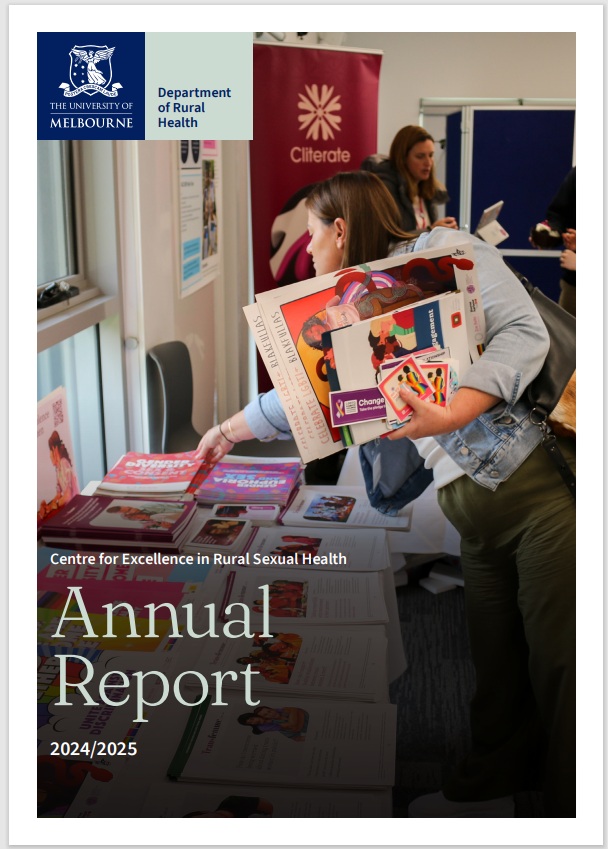
Our most recent annual report is available here, as well as our current strategic plan.
Our position statements
Please find below our position statements on the following aspects of sexual and reproductive healthcare.
-
Every pregnant individual has the right to make a considered and informed decision for themselves and should have the support they need to decide how they will manage a pregnancy. All options available in relation to managing a pregnancy should be readily accessible to a pregnant person, including abortion.
Abortion is a safe and legal medical procedure in Victoria. While access is still limited, providers are located in both Melbourne and regional Victoria in a range of health services and private practices. CERSH works actively to increase access to abortion services in regional Victoria.
-
Every individual is entitled to access comprehensive information and services regarding a full range of contraception options. Equitable availability is essential, ensuring adherence to contemporary safety and efficacy standards while respecting the diverse needs of all people.
CERSH emphasises the importance of providing high-quality, evidence-based education and clinical contraception services, empowering individuals to make informed decisions about their reproductive health and wellbeing.
-
Every individual has the right to express their gender identity and sexuality freely and safely without fear of discrimination, within a culture of respect and inclusion.
Sexual orientation and gender identity must be considered in regards to the accessibility, accommodation and acceptability of health services, social services, and education settings as well as associated resources.
CERSH embraces the diversity of all individuals, including those who identify as lesbian, gay, bisexual, transgender, queer, intersex, and all other genders and sexual orientations.
-
Pleasure is an essential aspect of sexual health and overall wellbeing. This stance is grounded in the understanding that sexual pleasure contributes significantly to an individual's holistic health, encompassing physical, emotional, spiritual and psychological dimensions.
CERSH advocates for a comprehensive understanding of sexual health which includes the promotion of pleasure as a fundamental element.
-
Relationships and sexuality education (RSE) is an integral component of a young person’s healthy development and wellbeing. Utilising a whole-of-school approach, RSE should be integrated across the curriculum and taught at all stages, inclusive of early years. The delivery of RSE should be evidence-based, and developmentally appropriate. Classroom teachers should be provided with appropriate training and support to provide RSE.
CERSH recognises the diversity in students’ identity, background and lived experiences. Therefore, RSE must be trauma-informed, cover broader social topics such as identity, relationships, consent, pleasure and sexual rights in addition to the biological components of sexually transmissible infections and contraception.
-
Pornography use can have both negative and positive impacts at individual and social levels. Individuals have the right to make decisions about pornography consumption, so long as these decisions do not impact other’s rights or safety.
While pornography consumption itself can lead to detrimental effects, these effects are exacerbated by broader social factors and a culture of sexual taboo. It is vital that children and young people receive age appropriate education in relation to pornography from trusted adults and teachers. Children need effective protection from exposure to pornography.
CERSH also acknowledges that for some people, pornography consumption may be part of a healthy and fulfilling sexual experience and identity.